USAID
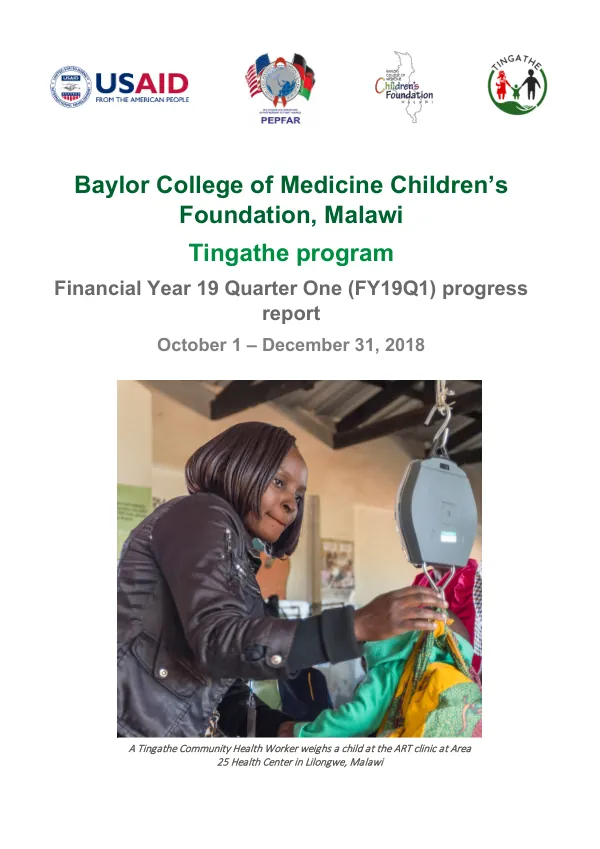
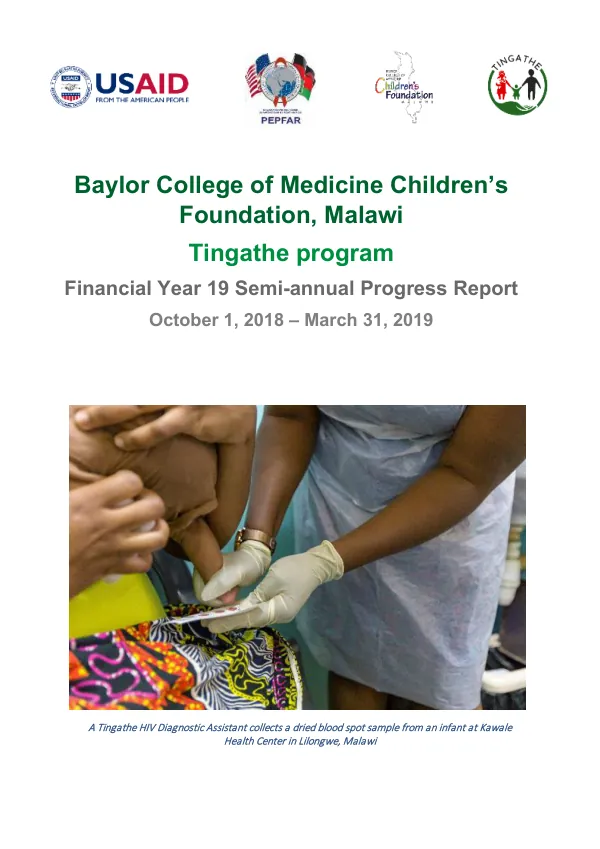
Financial Year 19 Semi-annual Progress Report October 1, 2018 – March 31, 2019
The Tingathe program is a technical support project to PEPFAR programs in the Southern Africa Region.
2019 · 51 pages
Sign in to readA free account is required to download.
Abstract
The program is implemented by Baylor College of Medicine Children's Foundation Malawi, with funding from the United States Agency for International Development (USAID). The program's primary goal is to improve HIV diagnosis, treatment, and care services in Malawi. The program operates in several key areas, including Active Case Finding, Active Linkage and Retention, Viral Suppression, and Health Systems Strengthening. Active Case Finding involves identifying new HIV cases through community outreach and testing. In the reporting period, the program conducted over 1,500 community outreach events, resulting in the identification of over 1,200 new HIV-positive cases. The program also implemented a viral load testing program, with over 10,000 tests conducted in the reporting period. The program's Active Linkage and Retention efforts focus on linking newly diagnosed individuals to antiretroviral therapy (ART) and retaining them in care. In the reporting period, the program achieved a linkage rate of 85%, with over 1,000 individuals initiated on ART. The program also implemented a client retention program, with a retention rate of 92% at the end of the reporting period. The program's Viral Suppression efforts focus on reducing the viral load of individuals on ART. In the reporting period, the program achieved a viral suppression rate of 85%, with over 8,000 individuals achieving viral suppression. The program also implemented a viral load cascade management program, which resulted in a 25% reduction in the number of individuals with unsuppressed viral loads. The program's Health Systems Strengthening efforts focus on improving the capacity of Malawi's health system to provide HIV services. In the reporting period, the program implemented several health systems strengthening activities, including the establishment of adolescent care services and the implementation of differentiated models of care. The program also conducted several operational research projects, including a study on the effectiveness of HIV self-testing kits. The program's Prevention efforts focus on reducing the transmission of HIV. In the reporting period, the program implemented several prevention activities, including the distribution of HIV self-test kits and the provision of gender-based violence (GBV) services. The program also implemented a cervical cancer screening program, with over 1,000 women screened in the reporting period. The program's Monitoring and Evaluation efforts focus on tracking the program's progress and identifying areas for improvement. In the reporting period, the program conducted several monitoring and evaluation activities, including the collection of data on program outcomes and the conduct of operational research studies. The program also published several articles and presented at several conferences in the reporting period. The program's Management and Operations efforts focus on ensuring the effective management and operation of the program. In the reporting period, the program implemented several management and operations activities, including the recruitment of new staff and the establishment of new program sites. The program also reported several success stories, including the integration of cervical cancer and HIV services for early detection and treatment in Malawi and the improvement of viral load coverage and suppression among people living with HIV in Mangochi, Malawi.