USAID DEC
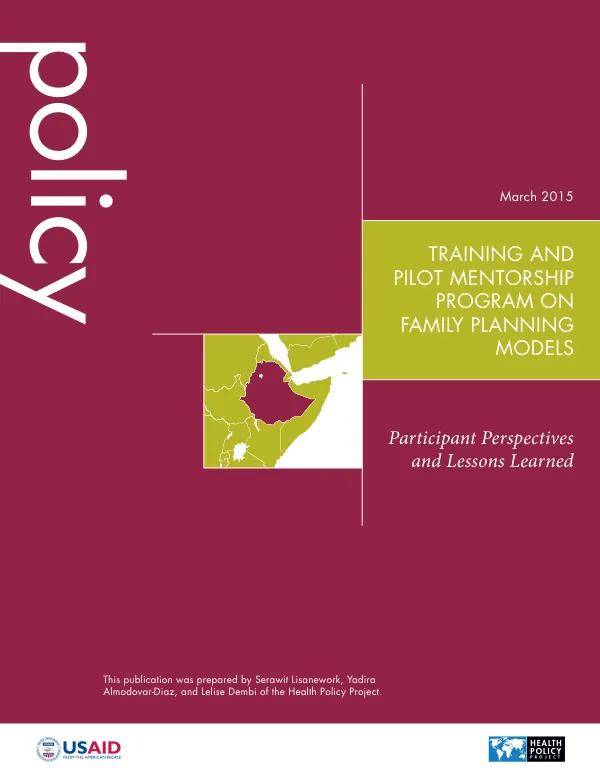
Training and Pilot Mentorship Program on Family Planning Models: Participant Perspectives and Lessons Learned
Sign inAVENIR HEALTH
Training and Pilot Mentorship Program on Family Planning Models: Participant Perspectives and Lessons Learned
The Health Policy Project in Ethiopia, funded by the USAID, aims to increase demand for and use of evidence for family planning and reproductive health services.
2015 · 19 pages
Sign in to readA free account is required to download.
Abstract
The project builds the capacity of leaders to support strategic planning, monitoring, and evaluation of programs nationally and in selected regions. Capacity-building activities address gender as a cross-cutting issue. Generating data and information to determine the impacts of family planning and reproductive health activities on health indicators and trends is essential for achieving program objectives and goals. To strengthen the capacity of national planning bodies, professional associations, training institutions, and research partners, the Health Policy Project collaborated with the Ethiopian Public Health Association to provide trainings and technical updates on key family planning and reproductive health models. The GAP Tool and a selection from the Spectrum System of Policy Models were among the models provided. In 2012, the Health Policy Project and the Ethiopian Public Health Association began a series of training-of-trainers sessions, basic trainings, and technical updates on the selected models. A total of 52 policymakers, experts, and academics have been trained, including individuals from various government institutions at the federal level and in the Amhara Region. The training aimed to equip participants with the skills to apply the Spectrum models and GAP Tool and produce policy briefs, fact sheets, and other materials to inform planning, implementation, and evidence-based decision making by policymakers and other key stakeholders. However, there was limited practical application of the models and use of the results for planning and advocacy purposes. To address this issue, the Health Policy Project and the Ethiopian Public Health Association designed and implemented a pilot mentorship program that paired selected trainees and master trainers as mentees and mentors, respectively. The mentorship program aimed to support the selected trainees in applying the Spectrum models and GAP Tool and producing policy briefs, fact sheets, and other materials. A total of 11 mentees and 7 mentors participated in the two-month program and produced nine evidence-based policy briefs. The assessment aimed to garner mentors' and mentees' perceptions about the importance of the training in building their capacity to use the GAP Tool and selected Spectrum models, gauge mentors' and mentees' perceptions about the mentorship program, and identify lessons learned and recommendations for scaling up the mentorship program. The assessment was conducted through individual interviews with mentors and mentees using a semi-structured questionnaire. Mentees described the Spectrum model training as very useful for understanding and applying the various tools. Some participants advanced their prior knowledge and skills using the tools, while others found the training to be a good refresher. The mentees also appreciated the opportunity to work with mentors and receive guidance and support. The mentorship program provided a platform for mentees to apply the skills learned and receive feedback from mentors. The mentees reported that the mentorship program was beneficial in helping them to apply the Spectrum models and GAP Tool and produce policy briefs, fact sheets, and other materials. The mentees also appreciated the opportunity to work with mentors and receive guidance and support. The mentorship program provided a platform for mentees to apply the skills learned and receive feedback from mentors. The assessment revealed that the mentorship program was effective in building the capacity of mentees to use the GAP Tool and selected Spectrum models. The mentees reported that they were able to apply the skills learned and produce policy briefs, fact sheets, and other materials. The mentorship program also provided a platform for mentees to receive feedback and guidance from mentors. The assessment recommended that the mentorship program be scaled up to reach more mentees and mentors. The program should be designed to provide ongoing support and guidance to mentees, including regular meetings and feedback sessions. The program should also be designed to provide opportunities for mentees to apply the skills learned and receive feedback from mentors. The assessment also recommended that the program be evaluated regularly to assess its effectiveness and identify areas for improvement.