USAID DEC
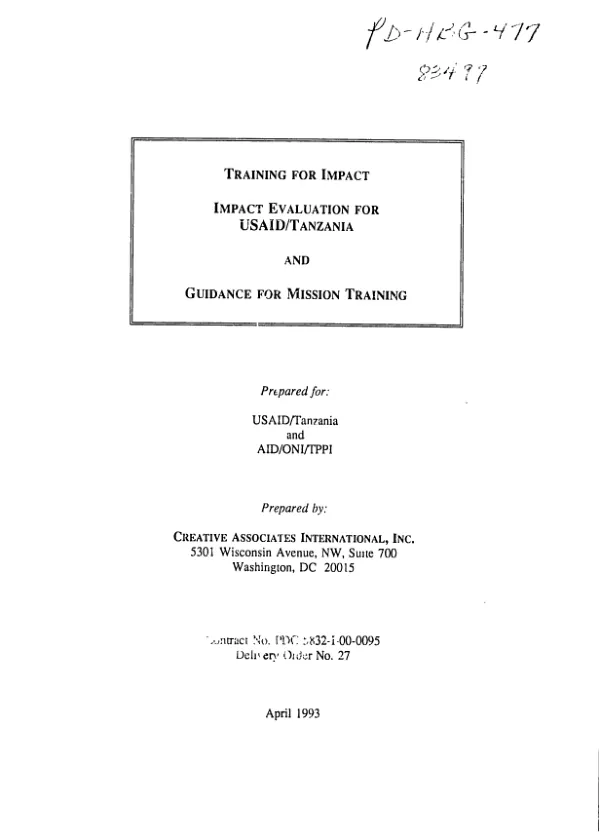
Training for impact : impact evaluation for USAID/Tanzania and guidance for mission training
Sign inCREATIVE ASSOCIATES INTERNATIONAL, INC. (CAII)
Training for impact : impact evaluation for USAID/Tanzania and guidance for mission training
Evaluates the impact of USAID/Tanzania's training initiatives.
1993
Sign in to readA free account is required to download.
Abstract
The evaluation, which employed the Training for Impact methodology, covers the period 1955-1992 and evaluates the Human Resources Development Assistance (HRDA) project as well as training funded under sectoral projects. Since 1955, USAID/T has funded U.S. and third-country training for nearly 4,000 Tanzanians and in-country training for hundreds more. HRDA alone has trained 257 Tanzanians since it began in 1989. Currently, training initiatives across sectoral projects and umbrella training projects constitute over 13% of the Mission's portfolio and total $13 million (cumulative since 1980). In reference to mandated targets, the participation of women in training is impressive, accounting for 49% of HRDA training and over 40% of all training. In-country training accounts for 73% of all training, but only 13% of HRDA training. The participation of the private sector is 8% Mission-wide and 20% in HRDA. In 1992, 8.2% of total person-months of U.S. training was at Historically Black Colleges and Universities (HBCUs), and 11.4% of new start person-months was at these institutions. There is clear evidence that USAID-funded training has had a positive impact on individual trainees, enabling them to take on added responsibilities with greater confidence and initiative, enhanced skills, and a wider perspective. Participants have been able to multiply the benefits of their training by advising others, providing on-the-job training, and speaking at workshops and conferences. Women appear to be able to utilize training as much as or more than the men. Although over 130 Tanzanian institutions have sent people for USAID training, it is not clear what the cumulative impact has been on the institutions since specific institutions have not been targeted for training; this is especially so in the case of HRDA, the majority of whose participants come from parastatals and government ministries. Participants from private firms report that they have effected change in the form of increased sales, new jobs, more products, and strengthened business ties with U.S. firms, but no baseline data are available to quantify or verify the impact. USAID/T has targeted three sectors for the period 1992-1997: health, infrastructure support, and the private sector. Current project training falls into those sectors, and the major fields of study to date under HRDA have closely paralleled these sectors, even though there is no clear mandate for HRDA to focus on the same sectors or to contribute to the achievement of Country Program Strategic Plan (CPSP) objectives. While HRDA participants in the health sector have contributed to specific needs, few have contributed to the CPSP objective of "health enhancing changes in reproductive behavior." In the private sector, participation has been able to contribute, to varying degrees, to "increased formal private sector employment and income growth." HRDA has also funded training in banking, road rehabilitation, and energy which has contributed to better delivery of services. HRDA has enjoyed excellent management, resulting in a project that is successfully meeting most placement targets. HRDA has also been successful in achieving individual impact, but has not systematically collected or analyzed data to demonstrate institutional or sectoral impact. Currently, the Participant Training Management System is not fully utilized to track training throughout the Mission or to record impact data for any Mission training. Overall, USAID/T training has been relatively successful, but the measurement of impact is somewhat limited because of the Mission's lack of strategic planning to measure training impacts in the areas detailed above. Recommendations to help the Mission prepare a new Country Training Strategy are provided. (Author abstract, modified)