USAID. MISSION TO EL SALVADOR
Training for productivity and competitiveness project
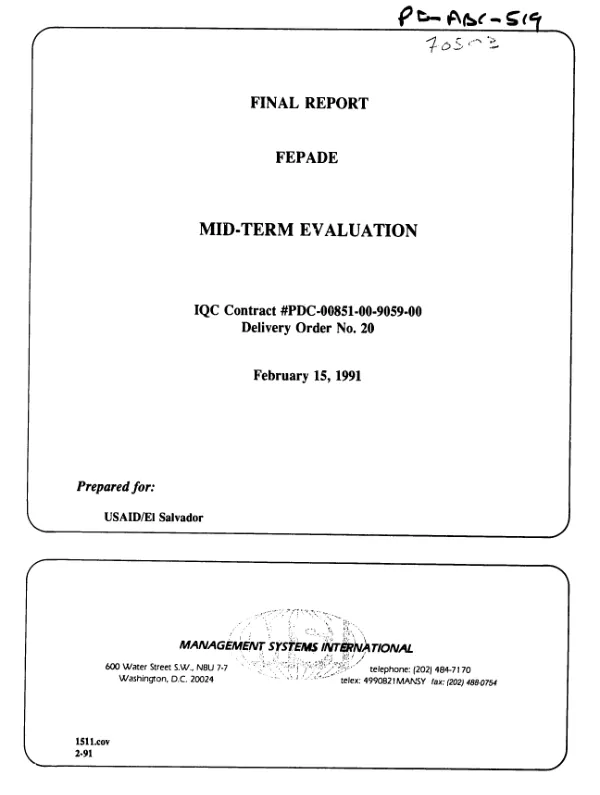
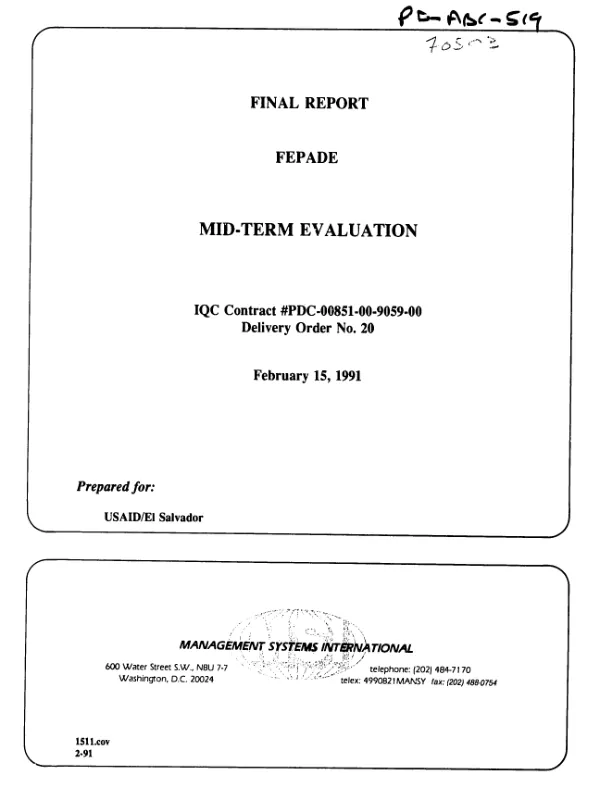
Summarizes mid-term evaluation (PD-ABC-519) of a project to provide technical/vocational or management training programs for private sector workers in El Salvador.
1991
Sign in to readA free account is required to download.

Abstract
The evaluation covered the period FY87-2/91. The project has already met or surpassed most of its goals and has developed a new set of activities. Most of the 7,000 people trained under the project have improved their employment situation, both in terms of promotions as well as in improved performance. This evidence suggests that the training has been relevant, effective, and well received. Resource allocation has reflected the private sector"s needs, with vocational training -- which has focused on the construction, apparel manufacturing, and automobile servicing sectors -- accounting for about 75% of the activities. The Foundation of Entrepreneurs for Educational Development (FEPADE), the implementing agency, has a decentralized administrative system that has allowed a high degree of autonomy in the two principal operations centers, the Technical/Vocational Department (TEC/VOC) and the Management/Administration (MGMT/ADMIN) Department. This has generated considerable creative energy in their respective training programs. TEC/VOC"s success is in large part due to the organization of courses on a modular basis and the use of competency-based instructional systems. In addition, TEC/VOC has not only contracted out training to a varied group of institutions, but also established a new institution (La Escuela Taller Automotriz) that is directly administered by FEPADE. The MGMT/ADMIN Department has established a graduate degree program in business administration in association with University Francisco Marroquin, which is now part of the project. However, FEPADE plans to incorporate all its management training under a semi-independent institution. In addition, FEPADE has been contracted through other international development agencies to administer two other large technical/vocational training projects. Nonetheless, progress toward establishing self-sufficiency within FEPADE and its training centers has been very slow, and FEPADE"s internal information systems are inadequate. Some problems also exist in annual budgeting and financial planning procedures; project expenditures have not been maintained at the expected level. The educational credit component has failed to achieve project goals, probably due to low demand for such loans. In addition, there is some concern that FEPADE is beginning to spread itself over too large a base. While emerging institutions must grow, they run the risk of fragmenting their energies if they diversify too much, too quickly.
![Youth enterpreneurial [i.e. entrepreneurial] development](https://covers.devme.ai/gen/42658.webp)
![Project assistance completion [report] : USAID project no. 519-0400 -- Salvadoran environmental non-governmental organization strengthening (SENS) : cooperative agreement no. 519-0400-A-00-2144-00 with the Pan American Development Foundation (PADF)](https://covers.devme.ai/gen/5915.webp)