USAID. MISSION TO EL SALVADOR
Youth enterpreneurial [i.e. entrepreneurial] development
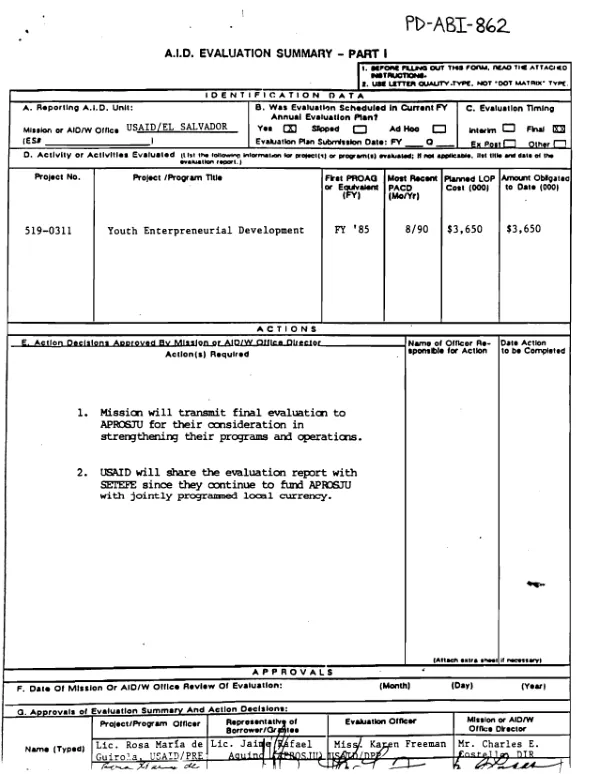
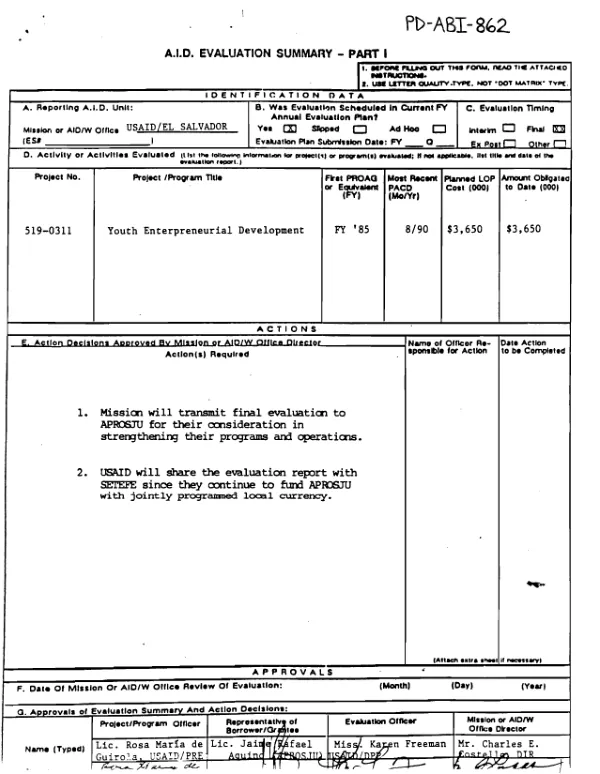
Summarizes final evaluation (XD-ABI-862-A) of a grant (8/85-8/90) to the Youth Development Association of El Salvador (APROSJU) to expand its Junior Achievement Program.
1993
Sign in to readA free account is required to download.
![Youth enterpreneurial [i.e. entrepreneurial] development](https://covers.devme.ai/gen/42658.webp)
Abstract
APROSJU has evolved from a monoservice operation, based in the capital, to a multifunctional institution with regional centers and national recognition for its services to youth. APROSJU has expanded its Junior Achievement (EJES) program to the cities of Sonsonate, Santa Tecla, Santa Ana, and San Miguel; added programs in computer literacy and applied economics; expanded its EXEJES program for alumni junior achievers; and established technical libraries in each regional center as well as a credit program for EXEJES graduates. These activities have provided the country"s youths with alternative educational experiences, enriched school curricula, and promoted free market principles. In particular, APROSJU"s libraries have provided Salvadoran youths with access to current reading materials not found in schools or rural areas. In addition, APROSJU has helped other Central American countries to establish Junior Achievement programs based on the Salvadoran model. Because of the swift growth it experienced during and as a result of USAID grant assistance, APROSJU did not rigorously address fundamental issues such as financial self-sufficiency and institutional effectiveness. Major problems included the following. (1) The grant proposal did not include sufficient guidance for project management, monitoring, and evaluation, nor define the responsibilities of key project personnel and institutions. (2) Underutilization of facilities (e.g., computer centers and libraries, and other buildings) reduced the project"s cost-benefit ratio. (3) APROSJU lacked a system by which to collect, analyze, store, and disseminate data. (4) Marketing and fundraising efforts were executed from each of the Regional Centers, which led to duplication of efforts, and wasting of time that could have been spent on policy making and institutional development. APROSJU"s sustainability still depends on the promise of external donations; its capacity to generate revenue is limited. It is recommended that APROSJU begin strategic planning based on a self-assessment guided by realism and not ideological dreams; conduct a market study in order to learn why certain strategies were successful and others were not; strengthen its internal structure and operations; and develop a management information, monitoring, and evaluation system.
![Evaluacion del programa de desarollo [i.e. desarrollo] del empresario juvenil (APROSJU) : El Salvador, 1985-1990](https://covers.devme.ai/gen/75379.webp)


![Microenterprise innovation program : cooperative agreement no. 940-0406-A-00-5246 [with Catholic Relief Services] -- close-out report](https://covers.devme.ai/gen/5658.webp)