USAID/NEPAL
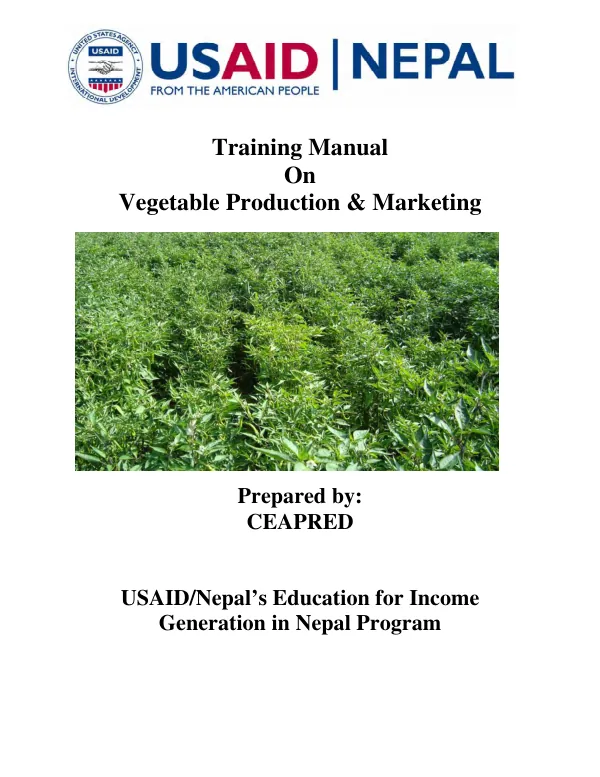
Training Manual for Vegetable Production and Marketing
The Vegetable Production and Marketing Training Manual is a comprehensive guide for farmers and agricultural professionals in Nepal.
110 pages
Sign in to readA free account is required to download.
Abstract
The manual is part of the Education for Income Generation in Nepal Program, supported by USAID. The program aims to improve the livelihoods of farmers and their families by improving their knowledge and skills in vegetable production and marketing. The manual covers various topics related to vegetable production and marketing, including soil solarization, nursery management, integrated pest management, and integrated plant nutrient management. The training programs outlined in the manual aim to equip farmers with the necessary skills and knowledge to improve their crop yields, reduce post-harvest losses, and improve their market access. The training programs are divided into four modules: Soil Solarization, Nursery Management, Integrated Pest Management, and Integrated Plant Nutrient Management. Each module includes detailed information on the topic, including the objectives, methodology, and expected outcomes. The training programs are designed to be practical and hands-on, with a focus on hands-on training and demonstrations. The manual also emphasizes the importance of community participation and involvement in the training programs. The training programs are designed to be participatory, with farmers and community members actively participating in the training sessions. The manual also emphasizes the importance of sustainability and scalability of the training programs. The training programs are designed to be implemented in a phased manner, with the first phase focusing on training the trainers. The trainers will then conduct training sessions for the farmers and community members. The training programs will be implemented in different districts of Nepal, with a focus on the districts with high potential for vegetable production. The manual also provides information on the training methodology, including the training methods, materials, and equipment. The training materials include textbooks, handouts, and visual aids. The training equipment includes audio-visual equipment, computers, and other equipment necessary for the training sessions. The manual also provides information on the evaluation and monitoring of the training programs. The training programs will be evaluated based on the achievement of the objectives, the quality of the training, and the impact of the training on the farmers and the community. The evaluation will be done through surveys, focus group discussions, and surveys. The training programs are expected to have a positive impact on the lives of the farmers and their families. The training will enable them to improve their income, reduce their poverty, and improve their living standards. The training will also contribute to the overall development of the country by improving the agricultural productivity and the income of the farmers. The manual is a valuable resource for farmers, agricultural professionals, and policymakers. It provides valuable information on the training programs, the methodology, and the expected outcomes. The manual will be useful for anyone interested in improving the livelihoods of farmers and their families. The training programs are designed to be sustainable and scalable. The training will be conducted in a phased manner, with the first phase focusing on training the trainers. The trainers will then conduct training sessions for the farmers and community members. The training will be conducted in different districts of Nepal, with a focus on the districts with high potential for vegetable production. The training will be conducted in a participatory manner, with the farmers and community members actively participating in the training sessions. The training will be conducted in a participatory manner, with the farmers and community members actively participating in the training sessions. The training will be conducted in a sustainable and scalable manner. The training will be conducted in a phased manner, with the first phase focusing on training the
Related documents