USAID DEC
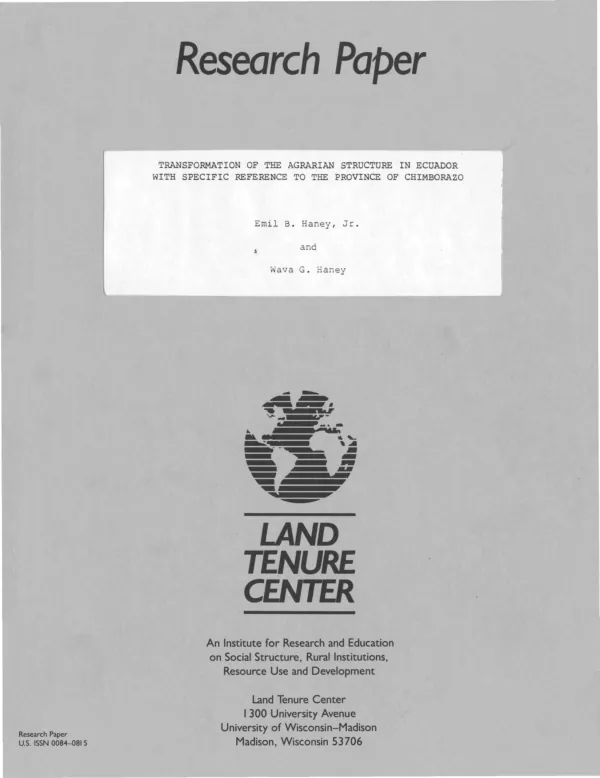
Transformation of the agrarian structure in Ecuador with specific reference to the province of Chimborazo
Sign inUNIVERSITY OF WISCONSIN AT MADISON. LAND TENURE CENTER (LTC)
Transformation of the agrarian structure in Ecuador with specific reference to the province of Chimborazo
Ecuador"s agrarian reform laws of 1964 and 1973, designed to redistribute land and distribute wealth more evenly, have fallen over 50% short of their goals.
Haney, Emil B., Jr.; Haney, Wava G. · 1987
Sign in to readA free account is required to download.
Abstract
Part one of this paper sketches the agrarian structure prior to 1964, assesses the impacts of the reform laws, and discusses major changes occurring in the agrarian structure today and their policy implications. Part two narrows the focus to Chimborazo Province, which was the province most affected by agrarian reform in terms of land area and number of beneficiaries. Data, derived mainly from public censuses, case studies, and a 1983 survey of 529 households, are presented on such topics as farm size, land tenure, land fragmentation, agricultural production, agricultural labor, migration, capital accumulation, economic activities, and income. Chimborazo"s experience with land reform is found to parallel closely that of Ecuador as a whole, two of its most salient characteristics being the increasing minifundization and proletariatization of the countryside. And while there have been notable improvements in housing and social infrastructure since the reform laws were enacted, very little economic surplus has been returned to the land and to rural communities. Further agrarian reforms, it is concluded, can help reduce - but certainly not eliminate - poverty and the continuing inequalities of the agrarian structure. A 4-page bibliography and 57 tables are included.