USAID DEC
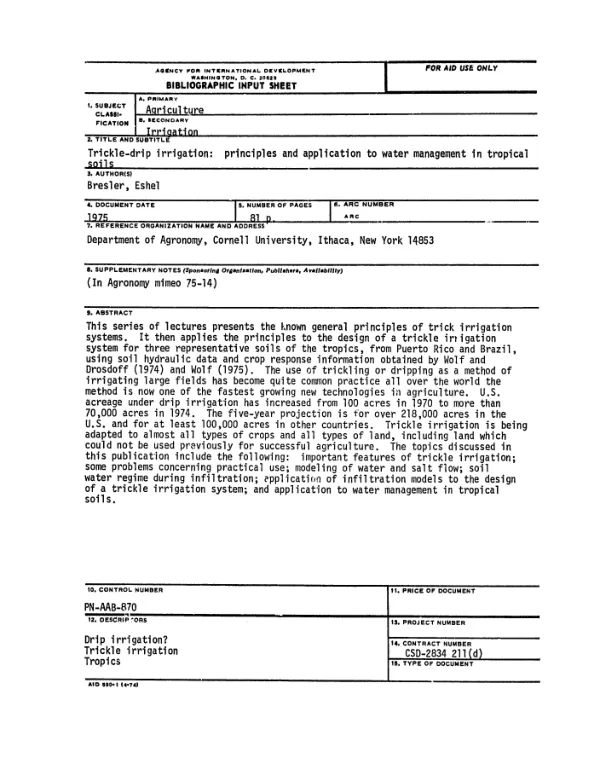
Trickle - drip irrigation : principles and application to water management in tropical soils
Sign inCORNELL UNIVERSITY
Trickle - drip irrigation : principles and application to water management in tropical soils
A series of lectures which present the known general principles of trickle irrigation systems.
Bresler, Eshel · 1970
Sign in to readA free account is required to download.
Abstract
It then applies the principles to the design of a trickle irrigation system for three representative soils of the tropics, from Puerto Rico and Brazil, using soil hydraulic data and crop response information obtained by Wolf and Drosdoff (1974) and Wolf (1975). The use of trickling or dripping as a method of irrigating large fields has become quite common practice all over the world the method is now one of the fastest growing new technologies in agriculture. U.S. acreage under drip irrigation has increased from 100 acres in 1970 to more than 70,000 acres in 1974. The five-year projection is for over 218,000 acres in the U.S. and for at least 100,000 acres in other countries. Trickle irrigation is being adapted to almost all types of crops and all types of land, including land which could not be used previously for successful agriculture. The topics discussed in this publication include the following: important features of trickle irrigation; some problems concerning practical use; modeling of water and salt flow; soil water regime during infiltration; application of infiltration models to the design of a trickle irrigation system; and application to water management in tropical soils.
Connected topics
Related documents