JEMBI HEALTH SYSTEMS, SA
Trouble-shooting data quality for better data use in Burundi
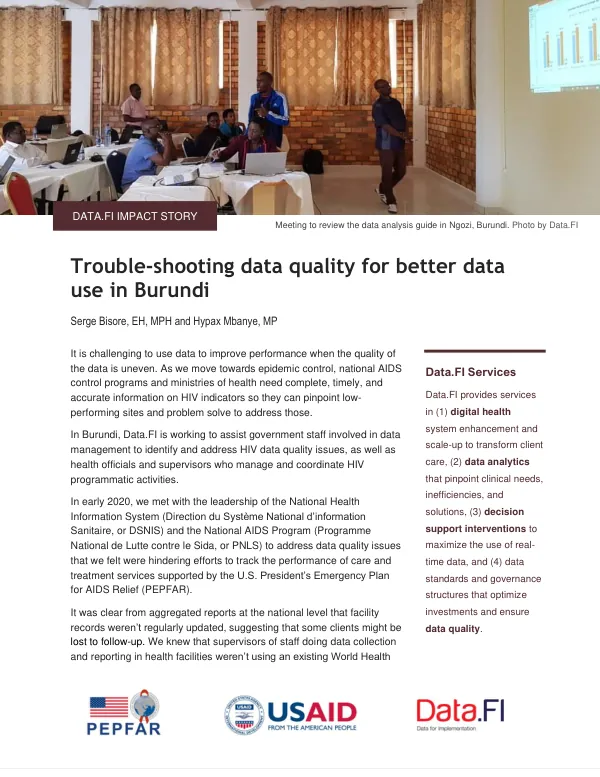
The National Health Information System (DSNIS) and the National AIDS Program (PNLS) in Burundi collaborated with Data.FI to address data quality issues hindering efforts to track the performance of care and treatment services supported by the U.S.
2020 · 3 pages
Sign in to readA free account is required to download.
Abstract
President's Emergency Plan for AIDS Relief (PEPFAR). Data.FI provides services in digital health system enhancement and scale-up, data analytics, decision support interventions, and data standards and governance structures. Data quality issues were evident in aggregated reports at the national level, indicating that facility records were not regularly updated, suggesting that some clients might be lost to follow-up. Supervisors of staff doing data collection and reporting in health facilities were not using an existing World Health Organization data quality review tool designed to help identify gaps in data reporting. The PNLS leadership felt that training on data quality was key, both at the central level and for supervisors of staff doing data collection and reporting in facilities. A stepwise plan was devised to strengthen the ability of supervisors to understand the story that the data were telling, so they could better help facility-based staff improve data quality. The plan included instituting "desk reviews" of data quality before supervisors traveled to the field for site data reviews, and making these a regular part of the PNLS monitoring and evaluation system. In July 2020, a training was convened with 14 central-level supervisors to conduct desk reviews on data quality, using the data quality review tool and a related PNLS manual for supervisors involved in overseeing HIV data in Burundi. The supervisors were asked to look at new data dashboards and to identify the facilities that had problems, and to link these data issues with HIV indicators to be able to monitor clinical cascade outcomes. These desk review meetings are now held regularly to prepare supervisors to conduct quarterly data review meetings at the district level. The PNLS leadership is starting to ask supervisors at implementing partners to probe for the underlying causes of the data quality issues, and colleagues are finding advantages in a stronger focus on preparation prior to field visits. Data.FI will continue to coach supervisors who go to the facility level to make sure those visits are well prepared and the teams well oriented. Supervisors need to know what their questions are, and where the data problems appear to lie. In time, these new habits will translate to curbing transmission, better treatment outcomes, and lives saved. Data.FI is a five-year cooperative agreement funded by the U.S. President's Emergency Plan for AIDS Relief through the U.S. Agency for International Development, and is implemented by Palladium, in partnership with JSI Research & Training Institute, Johns Hopkins University, Right to Care, and other organizations.