USAID. MISSION TO TUNISIA
Tunisia -- low cost shelter program : Mellassine upgrading component
Summarizes final evaluation of the Mellassine Upgrading Component of a Housing Guaranty Program to assist the Government of Tunisia (GOT) in responding to the housing needs of low-income groups.
1989
Sign in to readA free account is required to download.
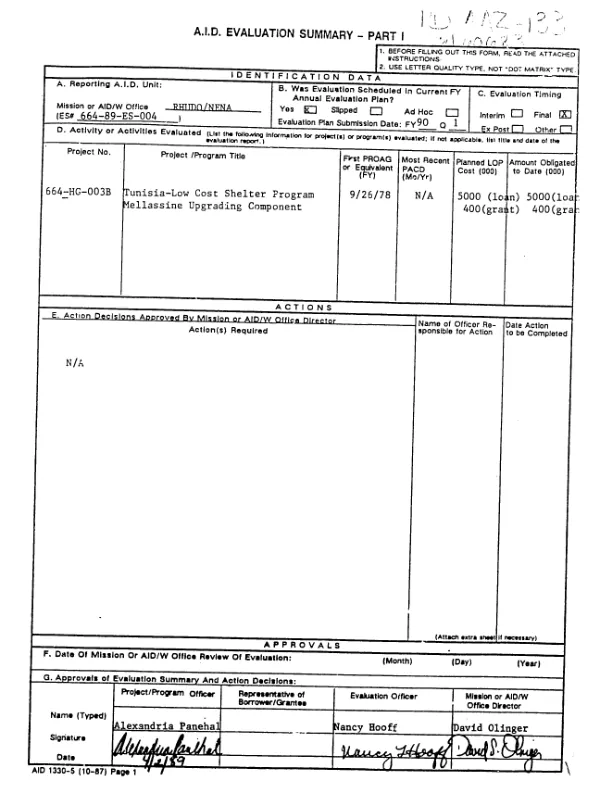
Abstract
Evaluation covered the period 1978-1988. The project achieved its major objective of bettering the living conditions of 2,400 households of the Mellassine neighborhood of Tunis by installing and improving infrastructure and services (electricity, potable water, sewerage, and roadway services). The project also encouraged owner-built housing by securing less rigid government construction regulations and beginning the process of securing land tenure for beneficiaries by facilitating the regularization/legalization of title deeds. Local currency depreciation also permitted the addition of stormwater drainage, two sports fields, and a cultural center as project outputs. Because of this project and the program as a whole, owner-built housing is now viewed by the GOT as the most suitable solution for low-income neighborhoods. Among the benefits resulting from these project elements were: (1) the integration of the community into the surrounding urban areas; (2) an increased sense of permanence and security amongst residents; (3) some $2 million in spontaneous beneficiary investments for home improvements during the project"s life; and (4) a marked reduction in population density both per dwelling and in the neighborhood as a whole. On the negative side, the project"s implementation period was seriously underestimated. The project was scheduled for completion in 4 years, while actual implementation took 11 years. Major reasons for this delay included: (1) incomplete technical designs; (2) the cumbersome bureaucratic procedures of the Municipality of Tunis (MOT); and (3) the MOT"s unfamiliarity with rehabilitation projects. In addition, there was little community participation in project development and implementation; although all households are connected to the public services, about a third of lower-income households cannot afford the costs of connection; and the project"s building material loan component was abandoned when it was discovered that substantial management difficulties would be entailed. The project taught the need to: (1) make project preparation as complete and detailed as possible to avoid redesign during implementation; (2) pay greater attention to cost recovery during project preparation to ensure replicability; (3) regard social management and community participation as central to project success; and (4) carefully coordinate the tasks of complex projects and where appropriate subcontract them.