MANAGEMENT SYSTEMS INTERNATIONAL
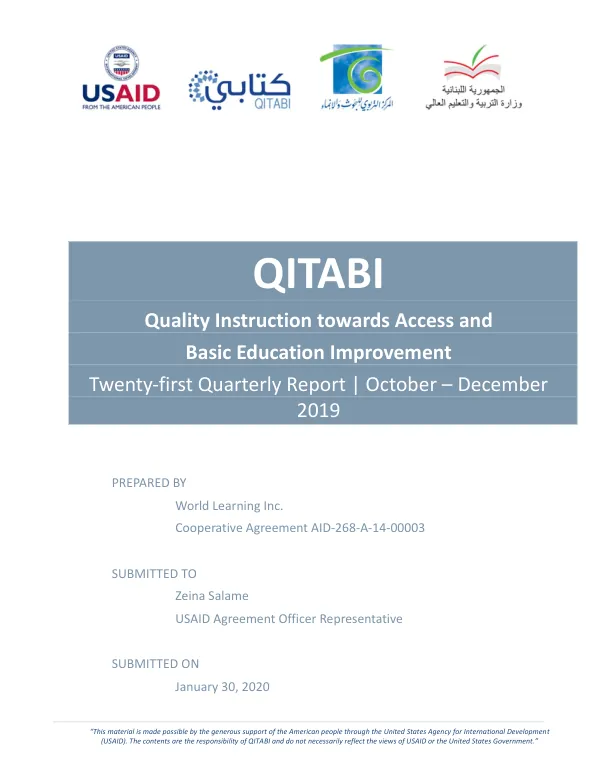
Twenty-first Quarterly Report | October – December 2019
The Quality Instruction towards Access and Basic Education Improvement (QITABI) program is a USAID-funded initiative aimed at expanding equitable access and improving learning outcomes for vulnerable students in Lebanese public schools.
2019 · 33 pages
Sign in to readA free account is required to download.
Abstract
The program, led by World Learning, is implemented in partnership with Ana Aqra', AMIDEAST, and Management Systems International. QITABI focuses on three key components: improving reading outcomes for primary level public school students, expanding access to safe and relevant education for vulnerable public school students, and strengthening management capacity in the education system. Component 1 of the program, Improved Reading Outcomes for Primary Level Public School Students, involves the implementation of the Balanced Literacy Approach (BLA) and the Early Grade Reading (EGR) program. The BLA is a comprehensive literacy program that focuses on phonics, fluency, vocabulary, and comprehension skills. The EGR program assesses the reading skills of students in grades 1-3 and provides targeted support to improve reading outcomes. As of the 21st quarter, the program has reached over 270 schools and has trained more than 1,500 teachers in the BLA and EGR programs. Component 2 of the program, Expanding Access to Safe and Relevant Education for Vulnerable Public School Students, aims to increase access to education for out-of-school children and vulnerable students. The program provides non-formal education (NFE) opportunities for students who have dropped out of school or are at risk of dropping out. The NFE program focuses on basic literacy and numeracy skills, as well as life skills and vocational training. As of the 21st quarter, the program has reached over 2,500 students and has provided NFE opportunities to over 1,000 students. Component 3 of the program, Strengthening Management Capacity in the Education System, focuses on building the capacity of the Ministry of Education and Higher Education (MEHE) to better direct and monitor education. The program provides technical assistance and capacity building to MEHE officials, focusing on areas such as education planning, budgeting, and monitoring and evaluation. As of the 21st quarter, the program has provided technical assistance to over 500 MEHE officials and has supported the development of a national student learning assessment framework. The program has made significant progress in achieving its objectives, with notable achievements including the distribution of teaching and learning materials to over 270 schools, the training of over 1,500 teachers in the BLA and EGR programs, and the provision of NFE opportunities to over 1,000 students. However, the program also faces challenges, including security concerns and limited resources. To address these challenges, the program has developed a comprehensive plan to distribute ICT classroom support models to cycle 1 classrooms in 270 schools and to newly opened classrooms from grades 1 to 6 in 260 Component 1 schools.