CREATIVE ASSOCIATES INTERNATIONAL INC.
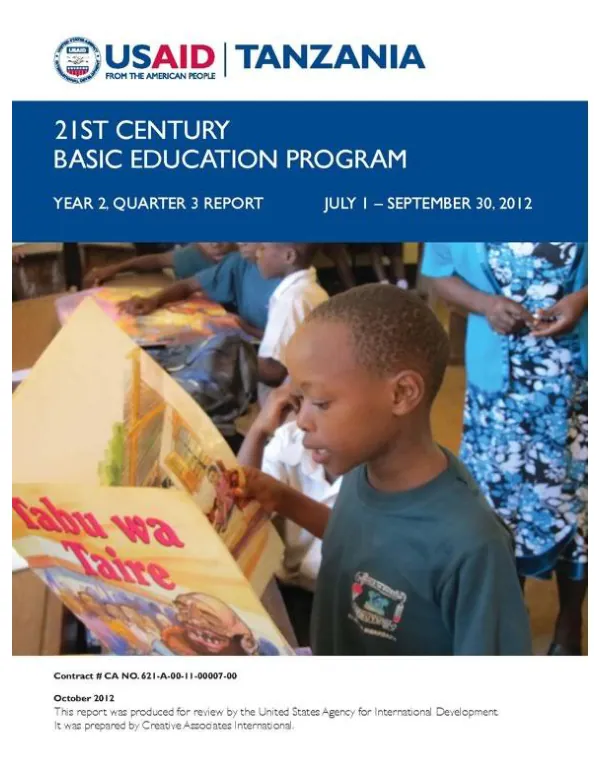
TZ21 Year 2, Quarter 3 Report, July – September 2012
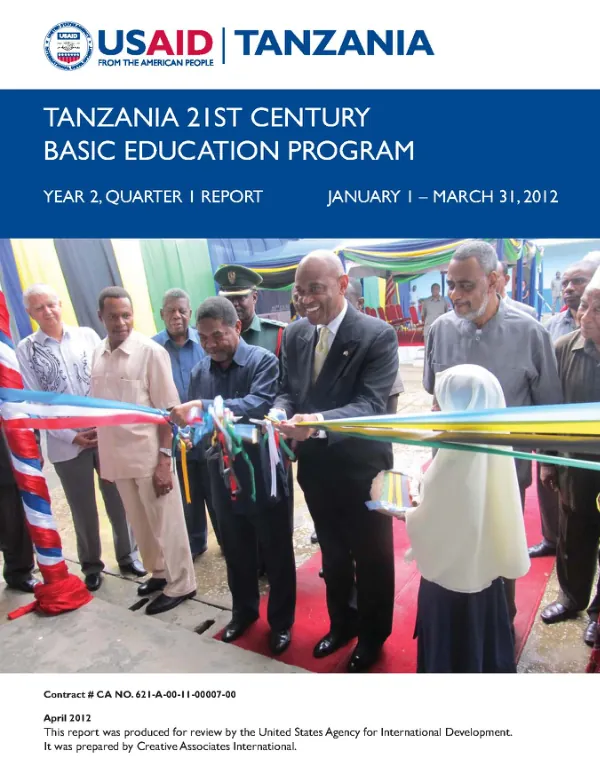
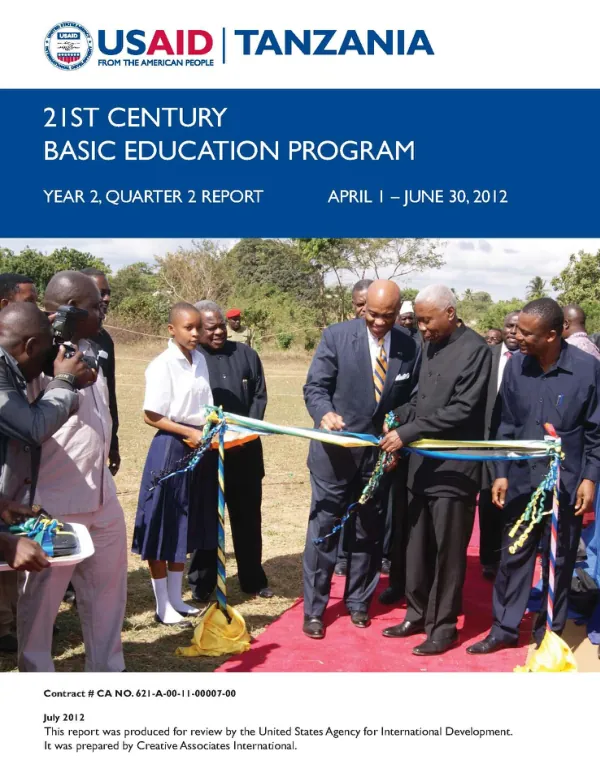
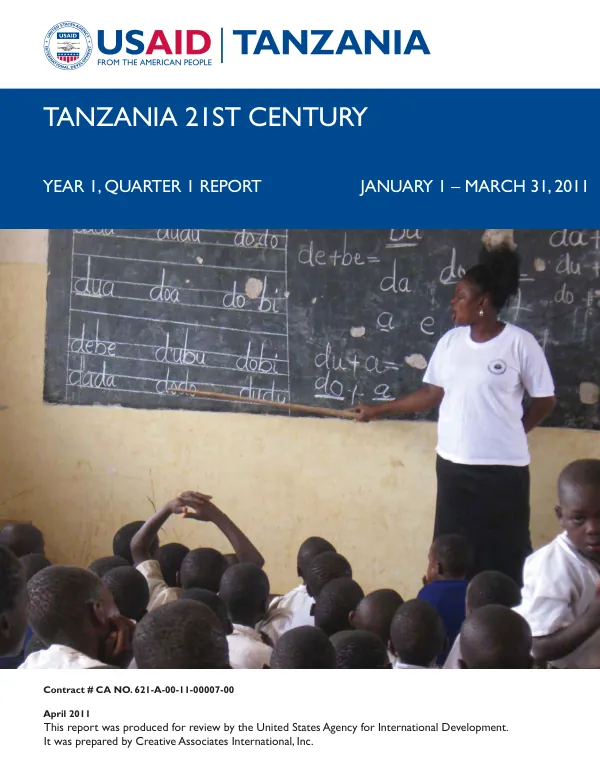
The 21st Century Basic Education Program (TZ21) is a five-year program funded by the United States Agency for International Development (USAID) in partnership with the Government of Tanzania.
2012 · 24 pages
Sign in to readA free account is required to download.
Abstract
The program aims to improve the quality of lower primary education with a particular focus on improved instruction in reading, mathematics, and science for higher learning achievement in Mtwara and in the islands of Unguja and Pemba in Zanzibar. The program is implemented under the Cooperative Agreement No. 621-A-00-11-00007-00 and awarded to Creative Associates International. The program's overarching goal is to provide technical and material support to the Ministry of Education and Vocational Training (MOEVT) in the Mainland and Zanzibar and to enhance the teaching and learning process using Information and Communication Technology (ICT). The program also strives to ensure a meaningful use of educational data by communities, schools, districts, regions, and national MOEVTs to enhance decision-making processes leading to and ensuring improved learning in reading, mathematics, and science in lower primary education in Mtwara and Zanzibar. The program promotes the new USAID/Tanzania Education Assistance Objective of "Improved lower primary education for higher achievement in reading, mathematics, and science." TZ21 will lay the foundation for this by working toward two sub-objectives or intermediate results (IRs): (1) Intermediate Result 1 (IR1): Strengthened professional development and resource support for schools, Teachers' Resource Centers (TRCs)/Teachers' Centers (TCs), and Teachers' Training Centers (TTCs), and (2) Intermediate Result 2 (IR2): Strengthened policies, information, and management systems. In Quarter 3, the main activities undertaken in Result 1.1: Strengthen the Use of Technology in Primary Schools, TRCs/TCs included the continuation of internet installation by UhuruOne and Zantel, ICT technical support and solution design for TZ21's interventions, Inveneo's final image preparation and testing by IPs, development of a content filtering solution design, and field surveys to assess school and TRC/TC readiness. The program also realigned its interventions to meet USAID's most recent priorities. The program's implementation is based on a combination of bottom-up and top-down approaches to support relevant interventions to realize anticipated project results and milestones. The program's progress towards achieving the project objectives is highlighted in the sections that follow. The program's activities are focused on providing focused technical assistance and professional support to primary school teachers, school administrators, students, school supervisors, and education officers within the project geographical coverage, improving infrastructure to enhance ICT integration to primary schools and teacher training institutions, providing e-curriculum and other instruction materials, establishing an Education Management Information System (EMIS) to improve decision-making processes, and supporting policy work. The program's geographic coverage includes Mtwara and Zanzibar, with a target of improving the quality of lower primary education for higher learning achievement in reading, mathematics, and science. The program's target beneficiaries include pupils, teachers, head teachers, and education stakeholders in Mtwara and Zanzibar. The program's reporting period is from July 1 to September 30, 2012, and the program's monitoring indicators include 31 indicators, consisting of 3 standard, 3 context, and 25 customized indicators. The program's implementation is led by Creative Associates International as the prime contractor, with international sub-recipients consisting of the International Youth Foundation (IYF), Agile Learning (AL), Inveneo, School-to-School International (STS), and Education Impact (EI), as well as with Children's Book Project (CBP), a national NGO. The program also has five Global Development Alliance (GDA) partners, including Microsoft, Intel, Cisco, UhuruOne, and Zantel.
Related documents