DEPUTY MINISTRY OF TECHNICAL AND VOCATIONAL EDUCATION AND TRAINING
Quarter Seven Report April-June 2009
The BridgeIT program in Tanzania began in 2007 with a two-year cooperative agreement from USAID/Tanzania.
2009 · 18 pages
Sign in to readA free account is required to download.
Abstract
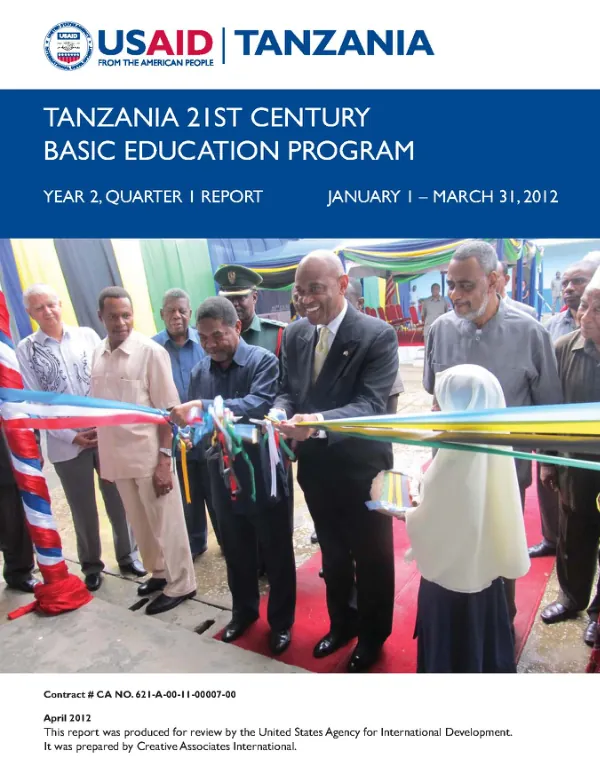
The program aims to increase educational quality and achievement among primary school students in mathematics, science, and life skills through the innovative use of cell phones and digital technology. BridgeIT is implemented in partnership with the Ministry of Education and Vocational Training (MoEVT), the Forum for African Women Educationalists (FAWE), the Nokia Corporation, the Pearson Foundation, and Vodacom Tanzania. The program has three specific objectives: to launch and expand BridgeIT in Tanzania and integrate it into the education system at low cost, to improve teacher performance in BridgeIT classrooms, and to increase learning gains among Standard Five and Six students in math, science, and life skills in BridgeIT classrooms, with a particular emphasis on girls. The program's main goal is to significantly increase the educational quality and achievement among students at primary school level. The seventh program report covers the period from April to June 2009. During this quarter, all activities planned for the seventh quarter were implemented as scheduled. Major activities included the national launch of the project, qualitative data collection, and monitoring visits. The national launch was held on April 15, 2009, at Mwenge Primary school in Dar es Salaam, and was attended by all BridgeIT partners, including USAID Mission Director Robert Cunnane, Deputy Minister of Education and Vocational Training Ms. Mwantumu Mahiza, and IYF President and CEO Bill Reese. The qualitative data collection exercise was conducted in select study and control schools in all areas of the country where the project is operating. The data was gathered using a combination of two qualitative data collection techniques: Focus Group Discussions (FGDs) and Key Informant Interviews with identified project stakeholders. The feedback obtained from this exercise is very positive, suggesting that teachers involved in the BridgeIT program are more comfortable and confident to teach their subjects with the use of the BridgeIT teaching model. Teachers have also been observed to employ participative teaching techniques more often and more effectively than their colleagues in control schools. Pupils are developing a greater interest in and understanding of mathematics and science through the video lessons. The evaluation team quoted one teacher at Mlimwa primary school in Dodoma commenting on the project as saying, "This thing (BridgeIT teaching model) is very good because pupils learn practically by seeing in addition to the normal lectures that way pupils are assisted into understanding the topic more easily." Focus group discussions have highlighted that students are frequently sharing the video lesson content with their friends and families on topics including HIV/AIDS, how to treat water to avoid the spread of cholera, and the digestive system. Parents in almost all study schools observed increased student morale to learn science and math subjects, increased student knowledge of science and math subjects, and improved student attendance in schools. The project staff continued to visit BridgeIT schools and provide backstopping support whenever needed. IYF Teacher Training Coordinator accompanied the qualitative evaluation team to all regions where the project operates in order to conduct classroom observations using the TALQ tool. This tool is designed to assess teachers' use of participatory and gender-responsive pedagogies in the classroom. The project has made significant progress in achieving its objectives, and the qualitative data collection exercise has provided valuable insights into the effectiveness of the program. The final summative evaluation report will be available in November, which will provide a comprehensive assessment of the program's impact.