USAID DEC
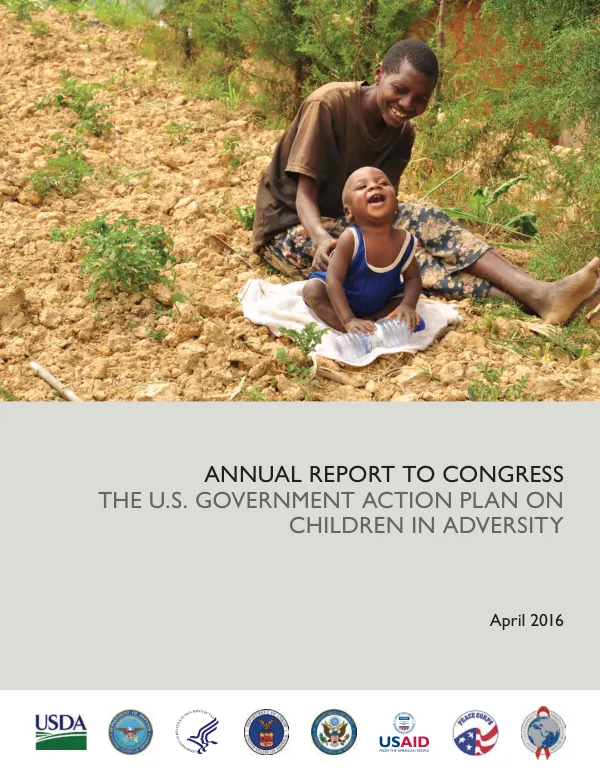
U.S. Government Action Plan on Children in Adversity - Annual Report to Congress, April 2016
Sign inDEPARTMENT OF AGRICULTURE
U.S. Government Action Plan on Children in Adversity - Annual Report to Congress, April 2016
The U.S.
2016 · 36 pages
Sign in to readA free account is required to download.
Abstract
Government Action Plan on Children in Adversity is a whole-of-government strategic guidance for international assistance for children. Launched in December 2012, the plan aims to achieve a world where all children grow up in protective family care and free from deprivation, exploitation, and abuse. The plan is built on the premise that child well-being, development, and safety are essential to advancing national progress. The Action Plan on Children in Adversity has six principal objectives and supporting objectives to promote greater U.S. Government coherence and accountability for international assistance to vulnerable children. The principal objectives are to build strong beginnings, put family care first, protect children from violence, exploitation, abuse, and neglect, strengthen child welfare and protection, promote evidence-based policies and programs, and integrate the Action Plan on Children in Adversity into U.S. Government agencies. The U.S. Government has committed to partnering with nations around the world to improve the well-being of children. Through the Action Plan on Children in Adversity, the U.S. Government has assumed the role of coordinating the whole-of-government response to children in adversity overseas. The U.S. Government Special Advisor on Children in Adversity, located in the USAID Center on Children in Adversity, has assumed the role of coordinating the whole-of-government response to children in adversity. The Action Plan on Children in Adversity has made significant progress in the past year. The plan has enabled countries to invest in their children, strengthen child health and nutrition, and reinforce family care. The U.S. Government has also promoted evidence-based approaches to improve the development outcomes for children in adversity. The plan has also promoted policies to sustain improvements in child welfare and protection. The U.S. Government has also made significant progress in implementing the Action Plan on Children in Adversity. The plan has been implemented in six priority countries, including Armenia, Colombia, Rwanda, and Uganda. The U.S. Government has also collaborated with multiple offices and agencies to respond to children in adversity overseas. The Action Plan on Children in Adversity has also made significant progress in promoting evidence-based policies and programs. The plan has promoted policies to sustain improvements in child welfare and protection. The U.S. Government has also promoted evidence-based approaches to improve the development outcomes for children in adversity. The U.S. Government has also made significant progress in integrating the Action Plan on Children in Adversity into U.S. Government agencies. The plan has been integrated into the U.S. Government agencies, including the Departments of Agriculture, Defense, Health and Human Services, Labor, State, and the Peace Corps. The U.S. Government has also assumed the role of coordinating the whole-of-government response to children in adversity overseas. The U.S. Government has also made significant progress in promoting policies to sustain improvements in child welfare and protection. The plan has promoted policies to sustain improvements in child welfare and protection. The U.S. Government has also promoted evidence-based approaches to improve the development outcomes for children in adversity. The U.S. Government has also made significant progress in promoting policies to sustain improvements in child welfare
Related documents