USAID DEC
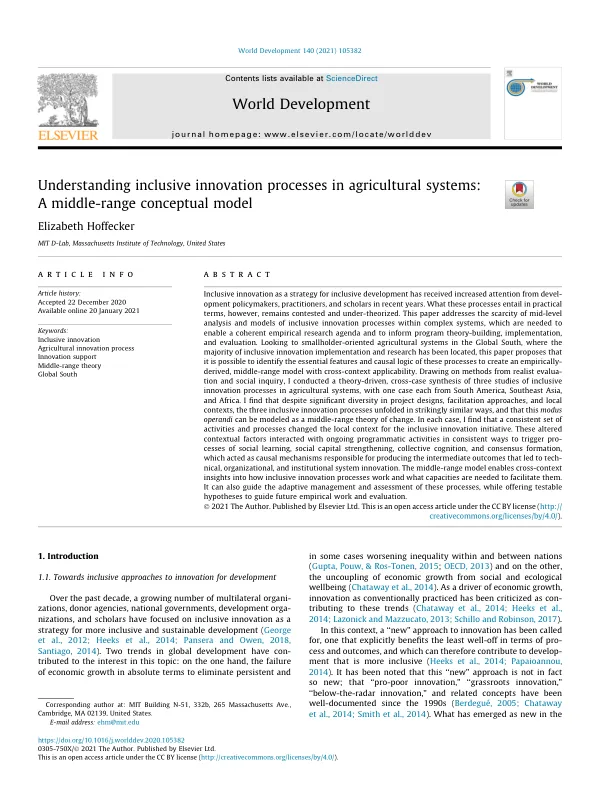
Understanding inclusive innovation processes in agricultural systems: A middle-range conceptual model
Sign inELSEVIER LTD.
Understanding inclusive innovation processes in agricultural systems: A middle-range conceptual model
Inclusive innovation as a strategy for development has gained attention from policymakers, practitioners, and scholars in recent years.
2021 · 16 pages
Sign in to readA free account is required to download.
Abstract
However, the practical terms of these processes remain contested and under-theorized. This paper aims to address the scarcity of mid-level analysis and models of inclusive innovation processes within complex systems. The focus is on smallholder-oriented agricultural systems in the Global South, where the majority of inclusive innovation implementation and research has been conducted. Drawing on methods from realist evaluation and social inquiry, a theory-driven, cross-case study of three studies of inclusive innovation processes in agricultural systems was conducted. The studies were located in South America, Southeast Asia, and Africa. Despite significant diversity in project contexts and facilitation approaches, the inclusive innovation processes unfolded in similar ways. A consistent set of activities and processes changed the local context for the inclusive innovation initiative, interacting with programmatic activities to trigger social learning, social capital strengthening, collective cognition, and consensus formation. These causal mechanisms were responsible for producing intermediate outcomes that led to technical, organizational, and institutional system innovation. A middle-range model of inclusive innovation processes was developed, enabling cross-context insights into how these processes work and what factors are necessary to facilitate them. The model can guide the management and assessment of these processes, while offering testable hypotheses for empirical work and evaluation. The paper focuses on inclusive innovation processes within agricultural systems in regions facing poverty and natural resource management challenges. This context was chosen because the majority of existing cases of inclusive innovation are located within it, and much of the work has been framed from a system perspective. The evidence on inclusive innovation in agricultural systems has been generated through site-level case studies, which detail how particular system innovation processes have unfolded. However, it is not advisable to extract generalizable lessons or recommendations from these case studies. Recent studies have conducted cross-case analyses of inclusive agricultural innovation processes, comparing processes across diverse geographic contexts and domains. These analyses have identified common features and outcomes of the cases, showing that inclusive innovation processes can be triggered by various circumstances and unfold in unpredictable, nonlinear ways. Stakeholders play a variety of roles and engage in a range of activities that evolve over the course of the innovation process. The cross-case analyses permit the identification of cross-cutting features of inclusive innovation processes in agricultural systems, albeit at a high level. These features include the triggering of inclusive innovation processes by various circumstances, the unfolding of these processes in nonlinear ways, and the engagement of stakeholders in a wide range of activities. The middle-range model of inclusive innovation processes developed in this paper can guide the management and assessment of these processes, while offering testable hypotheses for empirical work and evaluation. The model can also inform the development of testable, middle-range theory that can guide subsequent empirical studies and implementation efforts focused on systems innovation. This theory can help to explain how inclusive innovation processes work and what factors are necessary to facilitate them. The development of this middle-range theory is the primary aim of the research project to which this paper belongs. The project seeks to develop testable, middle-range theory that can guide the implementation of inclusive innovation in the context of systems change. This theory can help to explain how inclusive innovation processes work and what factors are necessary to facilitate them. The project focuses on inclusive innovation processes within agricultural systems in regions facing poverty and natural resource management challenges. The evidence on inclusive innovation in agricultural systems has been generated through site-level case studies, which detail how particular system innovation processes have unfolded. However, it is not advisable to extract generalizable lessons or recommendations from these case studies. Recent studies have conducted cross-case analyses of inclusive agricultural innovation processes, comparing processes across diverse geographic contexts and domains. These analyses have identified common features and outcomes of the cases, showing that inclusive innovation processes can be triggered by various circumstances and unfold in unpredictable, nonlinear ways. Stakeholders play a variety of roles and engage in a range of activities that evolve over the course of the innovation process. The cross-case analyses permit the identification of cross-cutting features of inclusive innovation processes in agricultural systems, albeit at a high level.
Related documents
Documents in this collection
 2017
2017USAID DEC
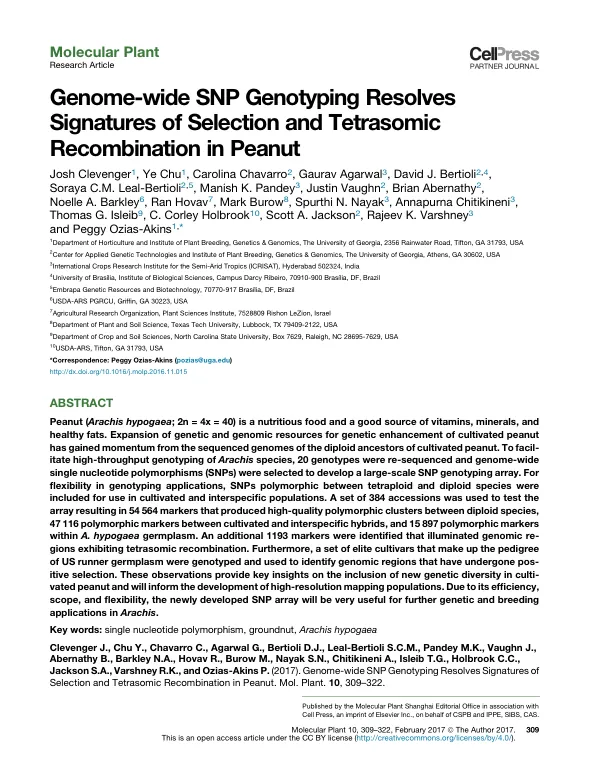
Genome-wide SNP Genotyping Resolves Signatures of Selection and Tetrasomic Recombination in Peanut
Open record 2023
2023USAID DEC