USAID DEC
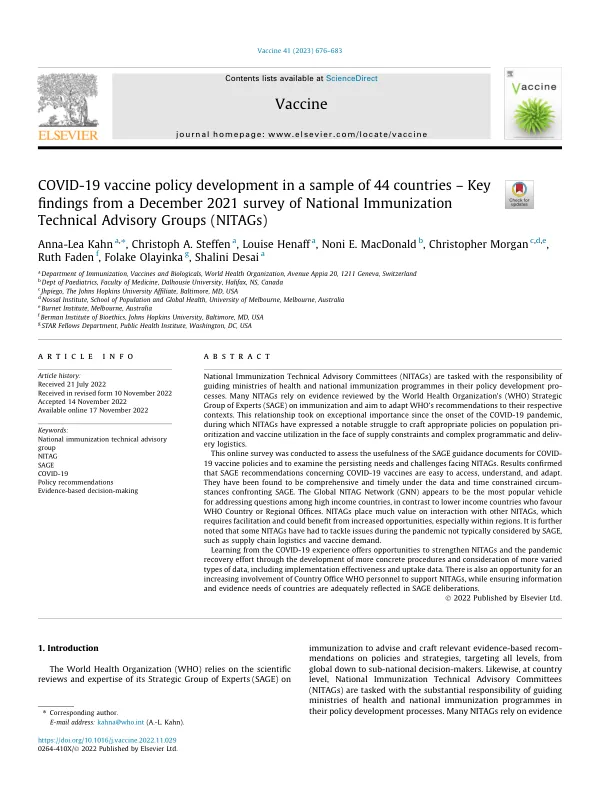
COVID-19 vaccine policy development in a sample of 44 countries – Key findings from a December 2021 survey of National Immunization Technical Advisory Groups (NITAGs)
Sign inBURNET INSTITUTE
COVID-19 vaccine policy development in a sample of 44 countries – Key findings from a December 2021 survey of National Immunization Technical Advisory Groups (NITAGs)
The COVID-19 pandemic highlighted the critical role of National Immunization Technical Advisory Committees (NITAGs) in guiding ministries of health and national immunization programs in policy development processes.
2023 · 8 pages
Sign in to readA free account is required to download.
Abstract
NITAGs rely on evidence reviewed by the World Health Organization's (WHO) Strategic Group of Experts (SAGE) on immunization and aim to adapt WHO's recommendations to their respective contexts. The SAGE was convened eleven times through virtual meetings in 2021 to discuss COVID-19 vaccination, issuing interim recommendations and accompanying evidence to recommendation frameworks for each vaccine product listed by the WHO for Emergency Use. NITAGs are considered an essential component of a functioning immunization system, serving as both a technical resource and a deliberative body to advise national authorities and policy makers seeking to make evidence-based decisions. The primary purpose of NITAGs is to assist Ministries of Health through the provision of information and guidance required to develop appropriate policies that consistently reflect the latest evidence, address national public health needs and contextual realities, and help build public confidence. The WHO has made the establishment and strengthening of NITAGs a priority, with the number of NITAGs tripling since 2010, bringing the total in 2021 to 170, with over 72% considered fully functional. A survey of NITAGs was conducted to assess the usefulness of SAGE guidance documents for COVID-19 vaccine policies and to examine the persisting needs and challenges facing NITAGs. The survey was available in English, French, Spanish, and Russian and was piloted among the six members of the Global NITAG Network (GNN) steering committee, representing each of the WHO regions. The survey aimed to rapidly assess the usefulness of SAGE products for COVID-19 vaccine policies and identify measures to enhance their uptake among NITAGs, as well as identify guidance and policy challenges facing NITAGs and National Immunization programs. The survey results confirmed that SAGE recommendations concerning COVID-19 vaccines are easy to access, understand, and adapt, and have been found to be comprehensive and timely under the data and time-constrained circumstances confronting SAGE. The Global NITAG Network (GNN) appears to be the most popular vehicle for addressing questions among high-income countries, in contrast to lower-income countries who favor WHO Country or Regional Offices. NITAGs place much value on interaction with other NITAGs, which requires facilitation and could benefit from increased opportunities, especially within regions. The survey also highlighted the challenges faced by NITAGs in crafting appropriate policies on population prioritization in the face of supply constraints and complex programmatic and vaccine delivery logistics. The COVID-19 pandemic has highlighted new challenges and needs underpinning the important role of NITAGs, including the task of delivering multiple products with varying handling requirements and use recommendations. The survey results provide valuable insights into the needs and challenges facing NITAGs and highlight opportunities for strengthening NITAGs and the pandemic recovery effort through the development of more concrete procedures and consideration of more varied types of data, including implementation effectiveness and uptake data.
Related documents