USAID DEC
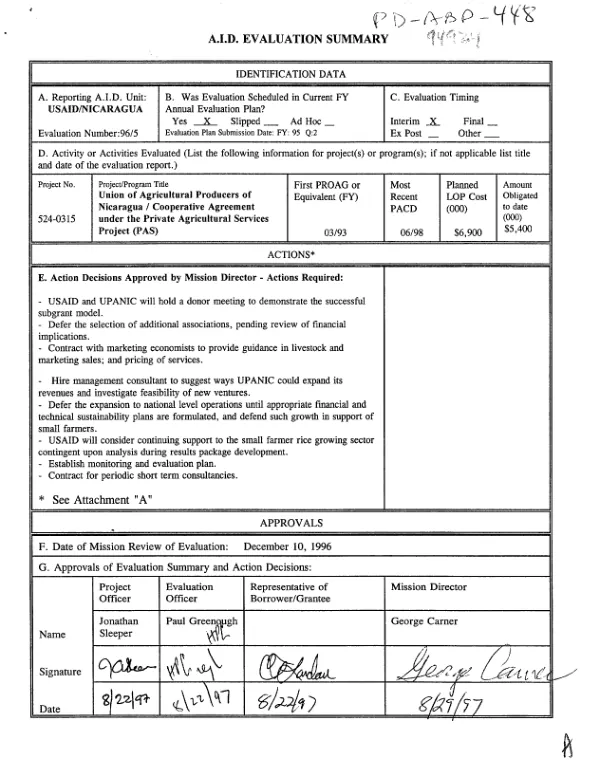
Union of Agricultural Producers of Nicaragua/cooperative agreement under the private agricultural services project (PAS)
Sign inUSAID. MISSION TO NICARAGUA
Union of Agricultural Producers of Nicaragua/cooperative agreement under the private agricultural services project (PAS)
Summarizes evaluation (XD-ABP-448-A) of a project to strengthen private agricultural services (PAS) in Nicaragua.
1997
Sign in to readA free account is required to download.
Abstract
Principally, the project provides subgrants for institution building and productive activities benefitting member federations and associations of the Union of Agricultural Producers of Nicaragua (UPANIC). Interim evaluation covered the period 3/93-9/96. The project, which has provided subgrants to primarily producer organizations, usually commodity-specific associations with provincial (municipio) or regional coverage, has already achieved many of its production objectives, with substantial economic benefits. The coffee and livestock projects are increasing the annual incomes of participating producers by $4.3 and $1.6 million, respectively. Although operating for a shorter period, the rice outreach project should generate net annual profits of $2.0 million in the coming year. Since this component is currently funded only through 9/97, it should be extended until the project as a whole ends in 1998. Annual benefits of this magnitude -- totaling almost $8 million per year -- are impressive for a project with a budget of $6.9 million and indicate a very favorable overall benefit-cost ratio. Field data indicate that coffee yields have increased by an average of 80% or 4.60 quintals per manzana (qq/mz) for more than 2,500 growers. This results in a net increase in income of $222 per mz, which is more than $800 per year for a typical small farmer in the project. Milk yields have increased by about 18%, and lactation periods and calving rates are also up. The net gain in profit due to milk and meat sales for a typical small producer is estimated at $660. The project has also strengthened UPANIC considerably. Membership in the associations has expanded by 142%, and members have greatly expanded their sales of inputs to growers. New activities such as the manufacture of livestock feeds are not only providing needed inputs to members, but also generating the profits needed to make the associations sustainable. However, the gross margins earned from these activities are often too low. Many associations do not yet have a workable approach to pricing and to ensuring the profitability needed to survive. To become sustainable, associations need assistance in business management and in assessing the feasibility of entering into new areas such as coffee processing. The way in which UPANIC has organized the subgrant process is one of the strengths of the program. Also, UPANIC has developed relatively standardized "modules" for major commodity areas: livestock, coffee, and basic grains. The modules are site-adaptable, thus permitting comparison and interchange of experiences between participating organizations. UPANIC staff has also developed the ability to help each association establish a strong institutional footing. All were assisted in setting up functional accounting systems, and, where necessary, guidance was provided in obtaining legal recognition. Finally, UPANIC has provided technical coordination at the national level. The Livestock Coordinator and the Coffee Coordinator have not only administered and monitored subgrants in their respective areas, but also coordinated the technical activities of the associations; the Coordinators hold periodic meetings of the associations" technical specialists and serve as links to outside sources of technical support. In rice production, the project has provided strong support, training, and coordination at the national level for the technicians stationed by the outreach program in each production region. Continuance of this type of coordination after project end will be essential if the associations are to continue to provide competent technical support for their members. The technical specialists in the associations will wither on the vine unless they have outside support and access to information.
![Evaluation : AIFLD [American Institute for Free Labor Development] cooperative agreement 524-0316-A-00-5065-00](https://covers.devme.ai/gen/82485.webp)
![Evaluation : AIFLD [American Institute for Free Labor Development] cooperative agreement 524-0316-A-00-5065-00](https://covers.devme.ai/gen/6488.webp)