USAID. MISSION TO INDONESIA
Upland agriculture and conservation
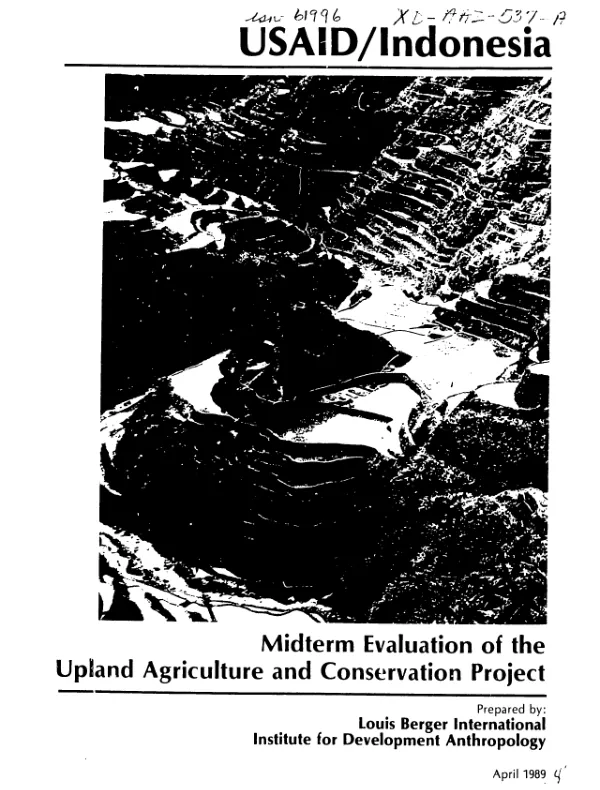
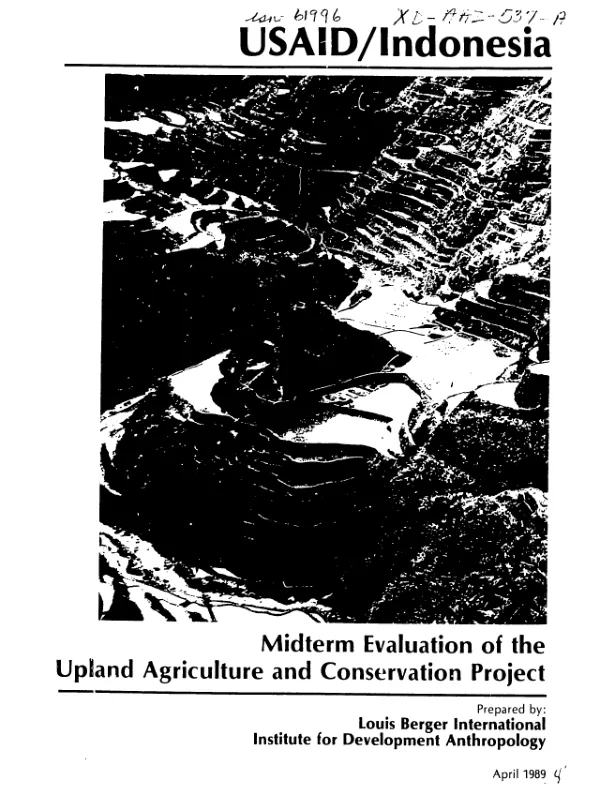
Summarizes mid-term evaluation (XD-AAZ-537-A) of a project to strengthen the capacity of Indonesian local government units to improve farming systems and technologies in the Jratunseluna and Brantas watersheds of upland central and east Java.
1989
Sign in to readA free account is required to download.
Abstract
Evaluation covered the period 7/84-4/89. Results are mixed. On the positive side, institutional development is clearly visible, particularly at the district level; 8 Project Management Units were created and are functioning well. In addition, the project has helped to place upland crops on the extension agenda and upland areas on the national development agenda. On the negative side, project implementation has been delayed, with only the roads and TA components proceeding at the expected pace, due in part to the inability of the Indonesian government to provide the agreed upon funding, and in part to a holdup in contracting TA. The Sustainable Upland Farming Systems (SUFS) program, the primary component of the project, has established demonstration plots in 75 of 80 planned locations. At these sites, limited success has been achieved in increasing crop production through new cropping systems, and in reducing soil erosion. Nonetheless, whether these two outputs will be sustained when project subsidies are ended is very much in doubt. Several design factors have hindered the SUFS program. (1) Soil conservation planning is dominated by bench terracing, regardless of the conditions. (2) Cropping systems should have been more varied, and included plantings of perennials. (3) Planning is not well adapted to the project areas"s diverse environmental conditions and farmer resources. (4) The hectarage targets are too large for the number of available extension agents. Other project components vary in degrees of success. (1) The construction of access roads has progressed well. (2) Training programs (including farmer, in-service, degree, and participant training) started slow, but will meet or exceed project targets. (3) The TA component continues to be fruitful and is a key factor in the progress of the project. (4) Soil surveys, recently completed, form an integral part of the project data base. (5) The farming systems research group shows promise, but still has major weaknesses. (6) The Project Innovation Fund has contributed little to the other components. (7) Policy studies have only just begun. The project provides two lessons concerning project design and management. (1) The project has simultaneously addressed two goals, complicating performance and impact analysis. (2) The large number of participants in this project make it difficult to manage. It is therefore important to design new ways to place more management burden on participating agencies and develop clear, written guidelines for all participants. The major recommendation is to strengthen the project"s management information system, so that the experience gained at the project"s 70 sites can be utilized in other efforts.