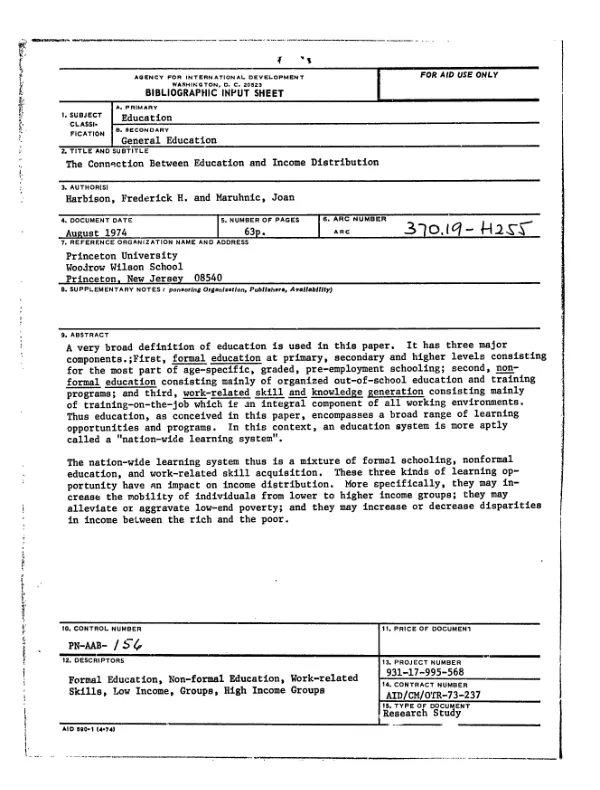
PRINCETON UNIVERSITY
Urban land policy, income distribution and the urban poor
This paper concerns the issues in the allocation of urban land, particularly as they affect the distribution of income.
Mohan, Rakesh · 1970
Sign in to readA free account is required to download.

Abstract
The problems are introduced by providing a view of the role of urbanization in economic development and the distribution of income in less developed countries (LDC"s). Section 2 discusses the potential of economic analysis to deal with these problems. Limitations of economic theory in providing policy guidelines are first discussed. Generalizations about location of people by income classes are offered and a typology of LDC cities suggested. Urban land is viewed as a heterogeneous good whose demand is derived from its various characteristics. Specifically, an approach to its income distribution effects is suggested by first analyzing it as an asset and then as a consumption good. That different income groups see urban land in different ways is emphasized. Finally, the working of urban land markets is described with an emphasis on the causes and consequences of speculation. The effects of the rise in price of urban land on the poor are discussed. Section 3 reviews various land policies in light of the framework suggested in the earlier section. An argument is made for urban planning to be particularly careful in the presence of fast changing conditions in LDC cities. Planning should also take account of the preferences of the people it affects. Policies directly affecting the poor are critically reviewed and a consumer oriented approach suggested. Section 4 is a summary of policy directions suggested and of the fruitful avenues of research.