PRINCETON UNIVERSITY
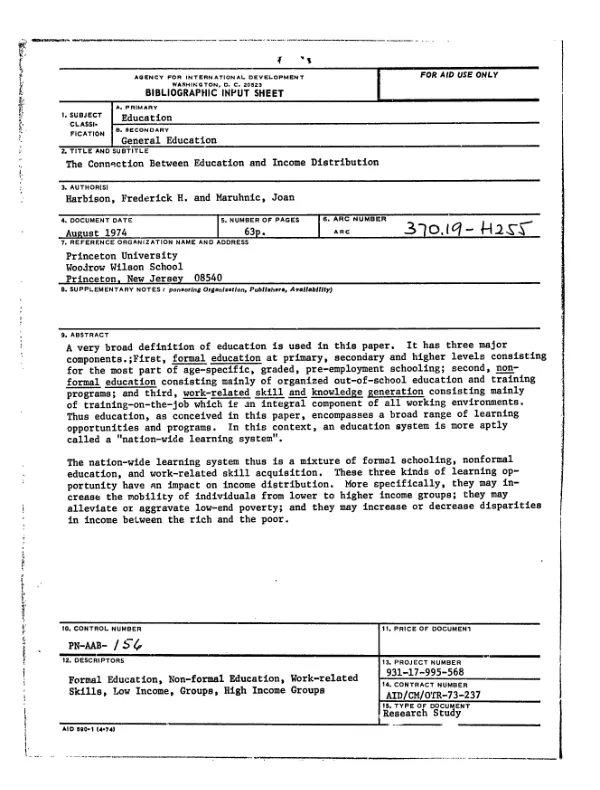
Connection between education and income distribution
A very broad definition of education is used in this paper.
Harbison, F. H.; Maruhnic, Joan · 1970
Sign in to readA free account is required to download.
Abstract
It has three major components: first, formal education at primary, secondary and higher levels consisting for the most part of age-specific, graded, pre-employment schooling; second, non-formal education consisting mainly of organized out-of-school education and training programs; and third, work-related skill and knowledge generation consisting mainly of training-on-the-job which is an integral component of all working environments. Thus education, as conceived in this paper, encompasses a broad range of learning opportunities and programs. In this context, an education system is more aptly called a "nation-wide learning system." The nation-wide learning system thus is a mixture of formal schooling, nonformal education, and work-related skill acquisition. These three kinds of learning opportunity have an impact on income distribution. More specifically, they may increase the mobility of individuals from lower to higher income groups; they may alleviate or aggravate low-end poverty; and they may increase or decrease disparities in income between the rich and the poor.
Connected topics
Related documents