USAID DEC
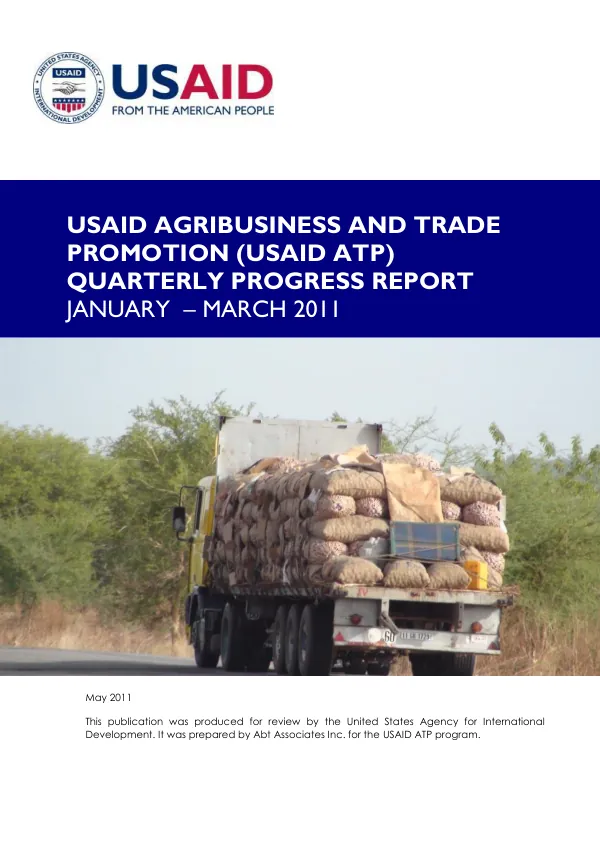
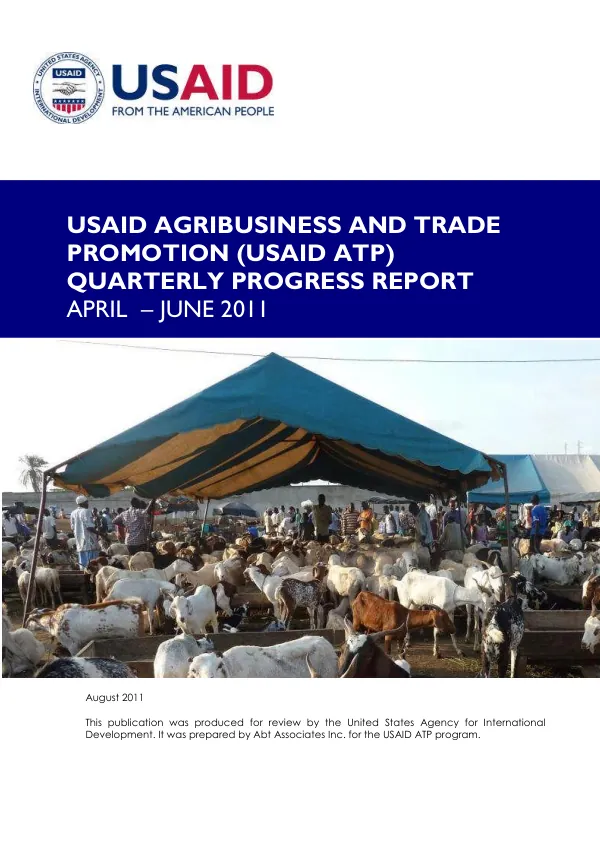
USAID Agribusiness and Trade Promotion (ATP) Quarterly Progress Report, April 2011 – June 2011
Sign inABT ASSOCIATES
USAID Agribusiness and Trade Promotion (ATP) Quarterly Progress Report, April 2011 – June 2011
The Agribusiness and Trade Promotion (ATP) program in West Africa aims to enhance regional agricultural trade and promote economic growth.
2011 · 51 pages
Sign in to readA free account is required to download.
Abstract
The program is implemented by Abt Associates Inc. in collaboration with various partners, including ACDI/VOCA and CARANA Corporation. The ATP program is funded by the United States Agency for International Development (USAID) and focuses on four key outcomes: reduced incidence of barriers to intra-regional agricultural trade, enhanced linkages among agricultural producers and agro-input suppliers, agro-processors, and distributors, more effective advocacy by actors for policies in support of a conducive environment for increased regional agricultural trade, and promoting efficiency of regional value chains. The program's approach is based on a value chain corridor-based approach, which involves identifying and addressing physical and policy-related barriers to trade. The ATP program has established partnerships with regional associations, including the Abidjan-Lagos Corridor Organization (ALCO) and the Association des vendeurs des produits locaux de Sikasso (APLS), to facilitate trade and improve market access. The program has also implemented market information systems, such as the Esoko platform, to provide farmers and traders with real-time market data and prices. One of the key highlights of the program is the reduction of transport-related physical barriers to trade. According to a survey conducted in April-June 2011, the number of roadblocks per 100 km decreased significantly, and the bribe costs paid by traders also decreased. The program has also made progress in updating value chain development plans, building the capacity of regional associations, and promoting business linkages among agricultural producers and agro-input suppliers, agro-processors, and distributors. The ATP program has also made significant progress in promoting efficiency of regional value chains. The program has implemented a market information system, which has enabled farmers and traders to access real-time market data and prices. The program has also mobilized additional finance through access to credit, warehouse receipts, and leverage. The program has also promoted the use of short messaging systems (SMS) to facilitate communication among farmers, traders, and other stakeholders. In terms of performance monitoring, the program has established a system to track progress and achievements. The program has also established a pipeline analysis to identify potential areas of improvement and to prioritize activities. The program has also conducted a performance monitoring report, which highlights the achievements of the program in the third quarter of FY 2011. The ATP program has also made significant progress in promoting intra-regional trade. The program has facilitated the trade of onions, livestock, and maize among West African countries. The program has also promoted the use of free on board (FOB) pricing, which has enabled traders to access international markets. The program has also facilitated the trade of agricultural products through the Economic Community of West African States (ECOWAS) trade liberalization scheme. Overall, the ATP program has made significant progress in promoting regional agricultural trade and economic growth in West Africa. The program has established partnerships with regional associations, implemented market information systems, and promoted business linkages among agricultural producers and agro-input suppliers, agro-processors, and distributors. The program has also promoted efficiency of regional value chains and facilitated intra-regional trade.