USAID DEC
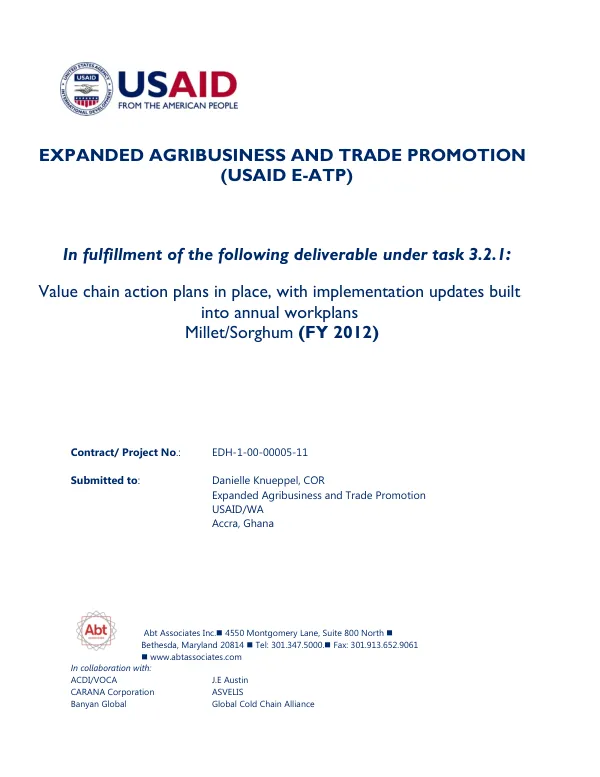
Expanded Agribusiness and Trade Promotion (E-ATP) Millet-Sorghum Value Chain Development Plan
Sign inABT ASSOCIATES
Expanded Agribusiness and Trade Promotion (E-ATP) Millet-Sorghum Value Chain Development Plan
The Expanded Agribusiness and Trade Promotion (E-ATP) Project is a USAID-funded initiative aimed at increasing the value and volume of intra-regional agricultural trade in staple food products in West Africa.
2012 · 30 pages
Sign in to readA free account is required to download.
Abstract
The project focuses on activities in key value chains, including millet/sorghum, rice, and poultry, and along key transport/trade corridors. The E-ATP Project is an expansion of the ongoing Agribusiness and Trade Promotion (ATP) Project, which was launched in 2008. The primary objective of E-ATP is to increase the value and volume of intra-regional agricultural trade in staple food products in West Africa in support of the Global Hunger and Food Security Initiative (GHFSI) and the Investment Plan of the Economic Community of West African States (ECOWAS) Agricultural Policy (ECOWAP). The project's vision is for a more competitive food processing sector and greater long-term trade relations between actors across the region. An assessment of the millet/sorghum value chain in West Africa and a regional stakeholders workshop identified priority actions for improving competitiveness. The findings highlighted several key challenges, including limited market incentives for value chain actors, an unstable policy environment, weak organizational capacity, and high transport and logistics costs. To address these challenges, E-ATP is implementing a value chain development plan (VCDP) for millet/sorghum activities. The VCDP is based on the findings of the assessment and workshop and aims to improve the competitiveness of the millet/sorghum value chain. The plan focuses on three key components: increasing regional trade in processed millet/sorghum products, increasing regional trade in raw millet/sorghum cereals, and leveraging E-ATP's cross-cutting technical resources. Component 1 of the VCDP aims to increase regional trade in processed millet/sorghum products by promoting opportunities for processors to access diversified, regional markets, upgrade equipment and operations, and develop consumer markets for new and existing millet/sorghum processed products. Component 2 aims to increase regional trade in raw millet/sorghum cereals by promoting long-term, cooperative trade relations between suppliers and traders and collaboration between stakeholders to advocate and implement campaigns to lift seasonal restrictions on the cereals trade. The E-ATP Project is working in collaboration with other USAID bilateral and regional programs to implement the VCDP. The project's activities are expected to have a catalytic impact in supporting West Africans to develop durable solutions to constraints in the millet/sorghum value chain. The VCDP for E-ATP activities in the millet/sorghum value chain is based on the following key findings: * Value chain actors have limited market incentives to invest in commercial millet/sorghum production, large-scale processing, and supply chain management practices. * Growth in millet/sorghum processed products has great potential to transform the value chain and infuse relations among actors with incentives for long-term, win-win cooperation. * An unstable policy environment prevents a more efficient and vibrant flow of information and cereals between surplus and deficit areas across the region. * Weak organizational capacity among producers and other value chain actors limits their potential to improve trade relationships and move beyond price-based bulk sales to more transparent, cooperative long-term trade relations. * High transport and logistics costs are due to corruption and roadway checkpoint delays. The E-ATP Project's vision for the millet/sorghum value chain is for a more competitive food processing sector and greater long-term trade relations between actors across the region. The project's activities are expected to contribute to achieving the 6 percent agricultural growth target set under the Comprehensive Africa Agriculture Development Program (CAADP) of the African Union's New Partnership for Africa's Development (AU-NEPAD).
Related documents