CRS
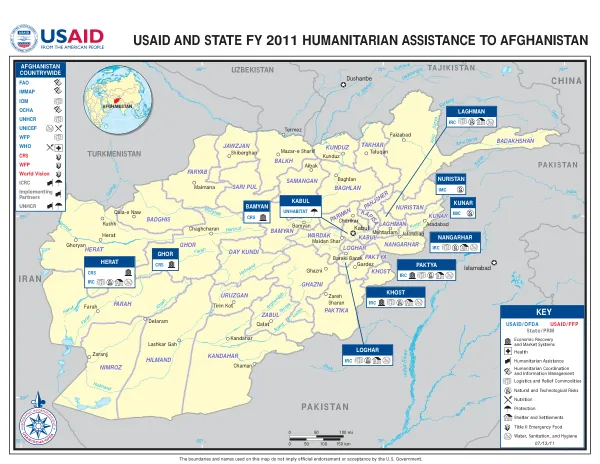
USAID AND STATE FY 2011 HUMANITARIAN ASSISTANCE TO AFGHANISTAN
The country of Afghanistan is a landlocked nation located in South Asia, bordered by Pakistan to the east and south, Iran to the west, Turkmenistan, Uzbekistan, and Tajikistan to the north, and China to the northeast.
2011 · 1 pages
Sign in to readA free account is required to download.
Abstract
The country's terrain is diverse, with mountains, deserts, and fertile valleys. The Amu Darya and Helmand rivers are two of the major waterways in Afghanistan. Afghanistan is divided into 34 provinces, each with its own capital city. The provinces are: Badakhshan, Badghis, Baghlan, Balkh, Bamyan, Day Kundi, Farah, Faryab, Ghazni, Ghor, Helmand, Herat, Jowzjan, Kabul, Kandahar, Khost, Kunar, Kunduz, Laghman, Logar, Nangarhar, Nimroz, Nuristan, Paktia, Paktika, Panjshir, Parwan, Samangan, Sar-e Pol, Takhar, Uruzgan, Wardak, and Zabul. The country's capital city is Kabul. The country's economy is primarily based on agriculture, with major crops including wheat, cotton, and tobacco. The country's natural resources include natural gas, coal, copper, and chromite. Afghanistan is also rich in mineral deposits, including iron, gold, and rare earth minerals. The country has a long history of conflict, with various factions vying for power over the years. The current government is a democratic republic, established in 2004. The country has made significant progress in recent years, with improvements in healthcare, education, and infrastructure. The humanitarian assistance provided by the United States Agency for International Development (USAID) and the State Department in 2011 focused on various sectors, including economic recovery and market systems, health, humanitarian assistance, humanitarian coordination and information management, logistics and relief commodities, natural and technological risks, nutrition, protection, shelter and settlements, and Title II emergency food, water, sanitation, and hygiene. The assistance was provided to various provinces, including Kabul, Khost, Laghman, Kunar, Nuristan, Paktia, Paktika, Logar, Nangarhar, and Herat. The implementing partners for the humanitarian assistance included the United Nations High Commissioner for Refugees (UNHCR), the International Rescue Committee (IRC), the International Medical Corps (IMC), the World Food Programme (WFP), the World Vision, the International Committee of the Red Cross (ICRC), and the Catholic Relief Services (CRS). The assistance was provided through various channels, including the United Nations Office for the Coordination of Humanitarian Affairs (OCHA), the Food and Agriculture Organization (FAO), the International Organization for Migration (IOM), and the United Nations Children's Fund (UNICEF).
Related documents