IBI
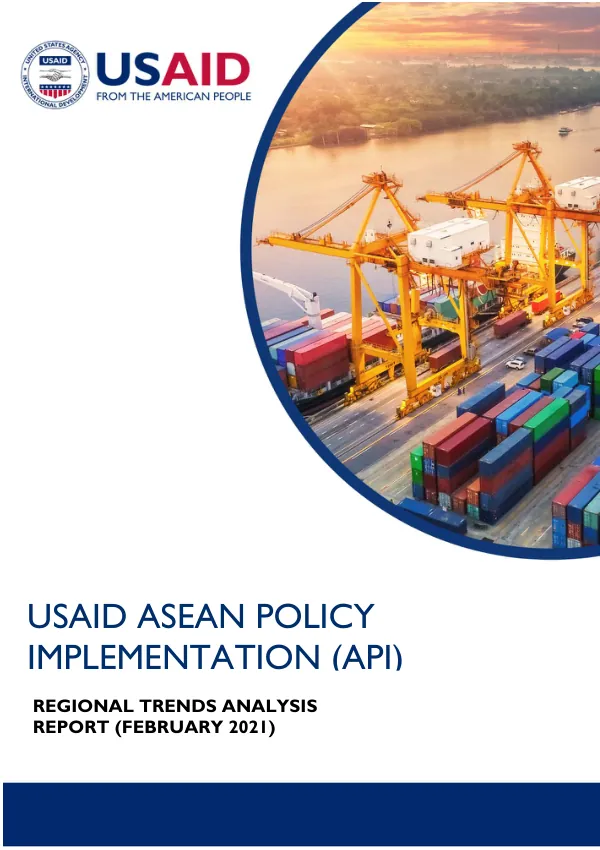
USAID ASEAN Policy Implementation (API) Regional Trends Analysis Report
ASEAN's current economic development is characterized by a multi-sectoral, multi-stakeholder, and "whole-of-ASEAN Community" approach in response to the COVID-19 pandemic.
2021 · 34 pages
Sign in to readA free account is required to download.
Abstract
This approach emphasizes prevention and control, adaptation, and recovery. ASEAN developed several policy responses to counter the impact of the pandemic, including the COVID-19 Response Fund, the Regional Reserve of Medical Supplies, the Strategic Framework for Public Health Emergencies, and the ASEAN Comprehensive Recovery Framework (ACRF). The ACRF contains two broad strategies in line with API objectives and activities, namely Maximizing the Potential of Intra-ASEAN Market and Broader Economic Integration, and Accelerating Inclusive Digital Transformation. These two broader strategies align with areas API is focused on, including the ASEAN Single Window (ASW) and Digital Data Governance (DDG). ASEAN continues to make progress on the ASW, with four ASEAN Member States (AMS) completing testing and going live with the exchange of the ASEAN Customs Declaration Document (ACDD) at the end of December 2020. For 2021, the current ASEAN's Chair, Brunei Darussalam, proposed ten Priority Economic Deliverables (PEDs) under the ASEAN Economic Community (AEC) Pillar that focused on recovery, digitalization, and sustainability. Under the digitalization strategic thrust, ASEAN will develop a work plan to address the implementation of the ASEAN Agreement on e-Commerce as their main Priority Economic Deliverables (PEDs) this year. The work plan will provide a common and harmonized approach for ASEAN to effectively implement the agreement, considering new dynamic and fast-changing digital technologies. One of the key ASEAN meetings in 2021 was the convening of ASEAN Digital Ministers Meeting in January 2021. At this meeting, the ASEAN Digital Masterplan (ADM) 2025 was endorsed to support the implementation of the ACRF and guide ASEAN's digital cooperation from 2021 to 2025. Furthermore, together with the endorsement of ADM 2025, ASEAN also developed the ASEAN Data Management Framework (DMF) and the ASEAN Cross Border Data Flows (CBDF) Implementing Guidelines. These two policy guidelines aim to harmonize data management and cross border data flows standards in the ASEAN region, raise the digital competitiveness of AMS, and build ASEAN's readiness to take up new digital opportunities. The Regional Comprehensive Economic Partnership (RCEP) is a multination trade agreement that was signed on November 15th, 2020 by the ten ASEAN Member States, and five ASEAN Free Trade Agreement (FTA) partners. RCEP aims to promote trade liberalization and facilitation, and to enhance economic cooperation among its member countries. The agreement covers trade in goods, services, investment, economic and technical cooperation, competition policy, intellectual property, and dispute settlement. ASEAN's economic priorities include promoting economic recovery, digitalization, and sustainability. The region is also focused on implementing the ASEAN Agreement on e-Commerce, which aims to promote rules-based e-commerce in the region. The agreement covers issues such as electronic authentication, digital signatures, and online dispute resolution. ASEAN is also working to develop a common and harmonized approach for implementing the agreement, considering new dynamic and fast-changing digital technologies. The ASEAN Digital Masterplan (ADM) 2025 is a key policy document that aims to support the implementation of the ACRF and guide ASEAN's digital cooperation from 2021 to 2025. The plan focuses on promoting digital economy, digital infrastructure, and digital skills development in the region. It also aims to enhance digital governance, cybersecurity, and data protection in ASEAN. The ASEAN Data Management Framework (DMF) and the ASEAN Cross Border Data Flows (CBDF) Implementing Guidelines are two policy guidelines that aim to harmonize data management and cross border data flows standards in the ASEAN region. The DMF provides a framework for data management in ASEAN, while the CBDF Implementing Guidelines provide a framework for cross border data flows in the region. These guidelines aim to raise the digital competitiveness of AMS and build ASEAN's readiness to take up new digital opportunities.
Related documents