IBI
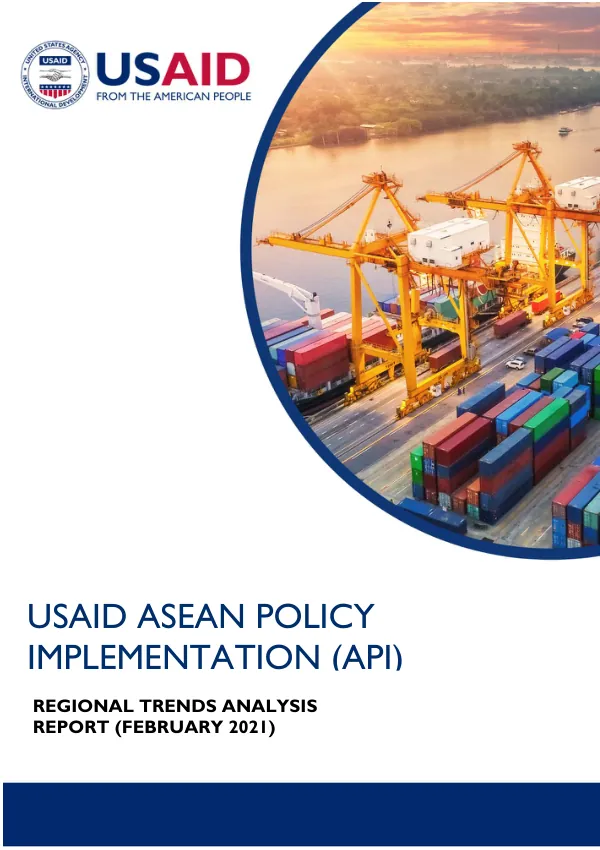
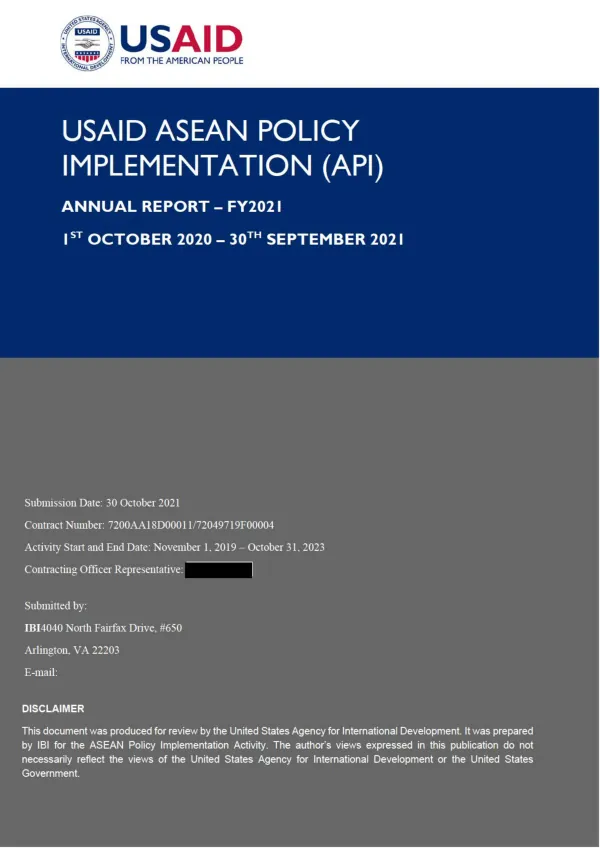
USAID ASEAN Policy Implementation Activity FY2021 Annual Report
The USAID ASEAN Policy Implementation (API) project aimed to provide technical assistance to the governments of the Philippines and Laos, conduct research on a regional level, and establish the baseline status of ASEAN member states in adopting the ASEAN National Single Window for trade.
2021 · 82 pages
Sign in to readA free account is required to download.
Abstract
During FY 2021, API provided targeted technical assistance to the Philippines Bureau of Customs (BOC), helping the BOC meet its commitment to accept the ASEAN Customs Declaration Document (ACDD) by December 2021. API experts conducted a series of interventions, including a data modelling workshop, a Business Processing Analysis (BPA) exercise, and the development of an RFP to develop and implement the ACDD management system. API also engaged a local expert to analyze the status of implementation of Laos' National Single Window (NSW) and ASEAN's policy on Digital Data Governance (DDG). However, API found it difficult to get the Government of Laos to make a formal request for assistance on the next steps to operationalize its NSW and participate in the ASEAN Single Window (ASW). API supported the translation and printing of the ASEAN-wide Self Certification Guidebook (AWSC) in seven languages, which provides information on AWSC as a trade facilitation initiative that allows exporters to demonstrate their ability to comply with the ASEAN Trade in Goods Agreement (ATIGA) rules of origin requirements. API was able to complete seven of the nine planned ASW baseline studies: Brunei Darussalam, Cambodia, Indonesia, Laos, Malaysia, Singapore, and Vietnam. However, the baseline study for Myanmar remained incomplete due to the coup in February 2021, which caused the research institution to cease operations. API was also able to complete four regional trends analysis reports during the reporting period, covering a wide range of ASEAN economic issues. The COVID-19 pandemic posed challenges for API project implementation, including travel restrictions that prevented the project team from developing personal relationships with government counterparts in the Customs Department in Laos. In the Philippines, the project team was able to build relationships with government counterparts due to existing personal ties. The project also had to revise its budgets to accommodate different financial scenarios due to delayed funding for FY 2022. API engaged USAID/Laos and USAID/Philippines at the end of September 2021 to design future technical assistance. The project's work focused on providing technical assistance to the governments of the Philippines and Laos, conducting research on a regional level, and establishing the baseline status of ASEAN member states in adopting the ASEAN National Single Window for trade. The project's activities aimed to support the implementation of targeted ASEAN policies at the member state level and provide concrete technical assistance to member states to strengthen their implementation of these policies. The API project's implementation was guided by the USAID ASEAN Development Cooperation Framework (DCF) and the ASEAN Framework on Digital Data Governance (FDDG). The project's activities were designed to support the implementation of the ASEAN Economic Community (AEC) Blueprint 2025 and the ASEAN Single Window (ASW) initiative. The project's work focused on providing technical assistance to the governments of the Philippines and Laos, conducting research on a regional level, and establishing the baseline status of ASEAN member states in adopting the ASEAN National Single Window for trade. API's technical assistance to the Philippines Bureau of Customs (BOC) aimed to support the BOC in meeting its commitment to accept the ASEAN Customs Declaration Document (ACDD) by December 2021. API experts conducted a series of interventions, including a data modelling workshop, a Business Processing Analysis (BPA) exercise, and the development of an RFP to develop and implement the ACDD management system. The project's work focused on providing technical assistance to the governments of the Philippines and Laos, conducting research on a regional level, and establishing the baseline status of ASE