FINTRAC
USAID-ATEP Quarterly Report #17 (April - June 2010)
The Agribusiness and Trade Expansion Program (USAID-ATEP) is a USAID-funded initiative aimed at promoting economic growth and poverty reduction in Ethiopia through the development of the country's agricultural sector.
2010 · 49 pages
Sign in to readA free account is required to download.
Abstract
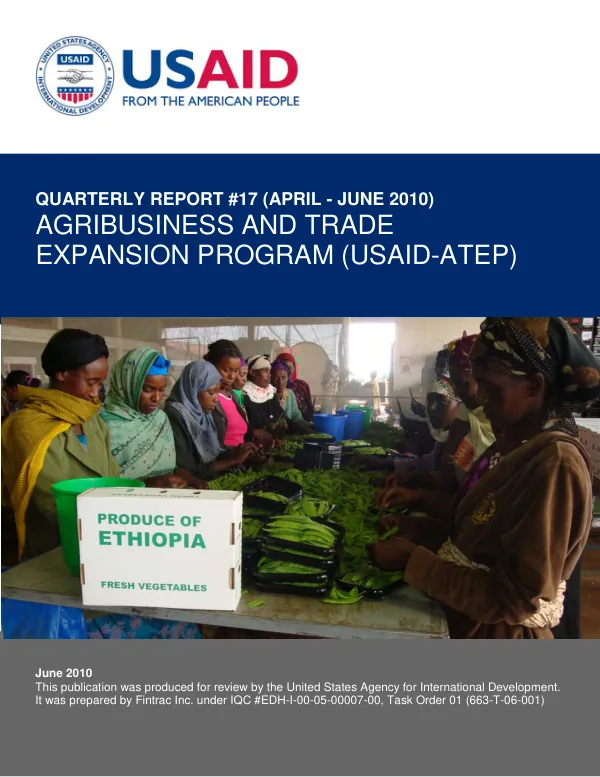
The program focuses on high-value and value-added horticulture, oilseeds and pulses, specialty coffee, and hides, skins, and leather. High-value and value-added horticulture is a key component of the program, with a focus on smallholder farmers. The CFC-EHPEA Smallholder Project provides training and technical assistance to smallholder farmers, with a goal of increasing their productivity and income. Commercial activity in the sector is also being promoted through the provision of business training and technical assistance to cooperatives and unions. Oilseeds and pulses are another key area of focus for the program, with a focus on smallholder clients. Training and technical assistance are being provided to smallholder farmers to improve their productivity and income. Business training is also being provided to cooperatives and unions to help them develop their capacity to export oilseeds and pulses. Specialty coffee is a growing sector in Ethiopia, and the program is providing training and technical assistance to smallholder farmers to improve their coffee production and quality. The program is also working to promote Rainforest Alliance certification and other specialty coffee initiatives, such as SCAA, Q grading, and Cupping. The program is also working to promote the development of the hides, skins, and leather sector, with a focus on technical assistance and training. An efficacy trial on Diazinon is being conducted to assess the effectiveness of this pesticide in controlling ticks and other pests. Business Development Services (BDS) initiatives are also being implemented to support the development of the sector. The Business Development Unit (BDU) is a key component of the program, providing business training to farmer organizations and other stakeholders. The unit is also working to promote market linkages and trade missions, and to provide technical support to the Ethiopian Commodity Exchange (ECX). In addition to its sector-specific activities, the program is also working on cross-cutting activities, including gender mainstreaming, environmental management, and communications and reporting. The program is also working to mainstream HIV/AIDS policy and programming at the workplace, and to promote income-generating activities for people living with HIV/AIDS, orphans and vulnerable children, and young adolescents. The program has made significant progress in achieving its quarterly export targets, with a 27% increase in exports of high-value and value-added horticulture products. The program has also made significant progress in promoting the development of the oilseeds and pulses sector, with a 25% increase in exports of these products. Looking ahead, the program plans to continue its focus on high-value and value-added horticulture, oilseeds and pulses, specialty coffee, and hides, skins, and leather. The program will also continue to work on cross-cutting activities, including gender mainstreaming, environmental management, and communications and reporting. The program will also continue to promote market linkages and trade missions, and to provide technical support to the Ethiopian Commodity Exchange (ECX). The program has received funding from the Technology and Partner Fund, which is being used to support the development of the sector. The program has also received funding from the Development Credit Authority (DCA), which is being used to support the development of the sector. The program has a number of success stories, including the development of a coffee liquoring unit (CLU) in Ethiopia, which has increased the country's coffee exports. The program has also supported the development of a number of cooperatives and unions, which have increased their productivity and income. The program's monitoring and evaluation plan is being updated regularly to ensure that the program is meeting its objectives. The program's performance is being tracked through a number of indicators, including the number of smallholder farmers trained, the number of cooperatives and unions developed, and the value of exports. Overall, the USAID-ATEP program is making significant progress in promoting the development of Ethiopia's agricultural sector, and in reducing poverty and improving the livelihoods of smallholder farmers and other stakeholders.
Related documents