FINTRAC
Feed the Future Tanzania Mboga na Matunda Monthly Update: May 2021
The Feed the Future Tanzania Mboga na Matunda (FTFT-MnM) activity is a five and a half-year initiative funded by the United States Agency for International Development (USAID).
2021 · 2 pages
Sign in to readA free account is required to download.
Abstract
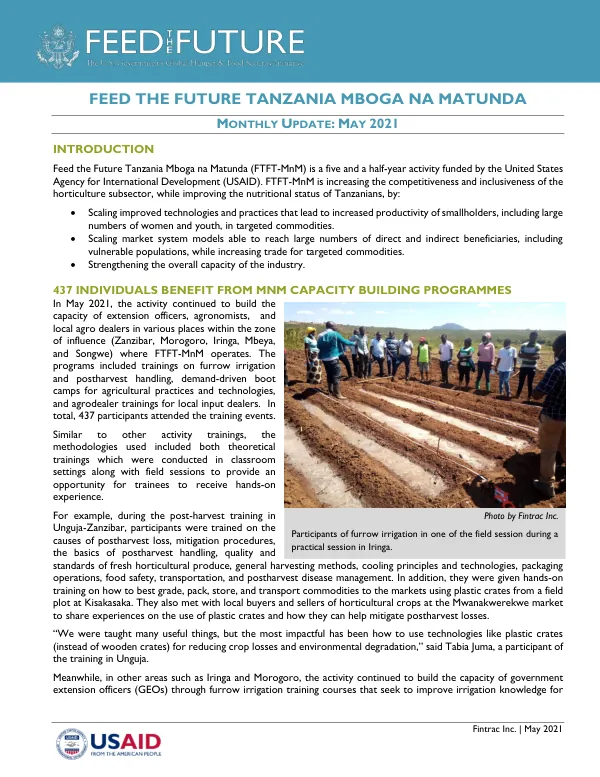
The program aims to increase the competitiveness and inclusiveness of the horticulture subsector in Tanzania, while improving the nutritional status of Tanzanians. Key objectives include scaling improved technologies and practices that lead to increased productivity of smallholders, particularly women and youth, in targeted commodities. Additionally, the program seeks to scale market system models that can reach large numbers of direct and indirect beneficiaries, including vulnerable populations, while increasing trade for targeted commodities. Furthermore, FTFT-MnM aims to strengthen the overall capacity of the industry. In May 2021, the activity continued to build the capacity of extension officers, agronomists, and local agro dealers in various places within the zone of influence (Zanzibar, Morogoro, Iringa, Mbeya, and Songwe). A total of 437 participants attended training events, which included sessions on furrow irrigation and postharvest handling, demand-driven boot camps for agricultural practices and technologies, and agrodealer trainings for local input dealers. The methodologies used included both theoretical trainings conducted in classroom settings and field sessions to provide hands-on experience. For example, during the postharvest training in Unguja-Zanzibar, participants were trained on the causes of postharvest loss, mitigation procedures, and the basics of postharvest handling, quality, and standards of fresh horticultural produce. The training programs also focused on building the capacity of government extension officers (GEOs) through furrow irrigation training courses. These courses aimed to improve irrigation knowledge for GEOs, who are crucial industry practitioners in helping smallholders improve productivity. The trainings covered topics such as land preparation, including soil preparation and ridge making for irrigation, water quality assessment, land mapping, proper crop spacing, furrow irrigation preparation, bed/ridge size preparation for effective crop irrigation, soil analysis, water management for sustainable irrigation, and climate smart agriculture. A total of 126 participants were empowered through furrow trainings that also provided knowledge on good agricultural practices and other farming technologies. The training programs have been successful in building the capacity of participants. For example, Tabia Juma, a participant of the training in Unguja, stated that the most impactful lesson learned was how to use technologies like plastic crates for reducing crop losses and environmental degradation. Similarly, Kondrad Asenga, a participant of the irrigation training in Mikumi, Morogoro, expressed his gratitude for the training and his intention to transfer the lessons learned to other smallholders in his area. The success of the training programs is a testament to the effectiveness of FTFT-MnM in building the capacity of smallholders and improving their productivity and profitability.
Related documents