USAID DEC
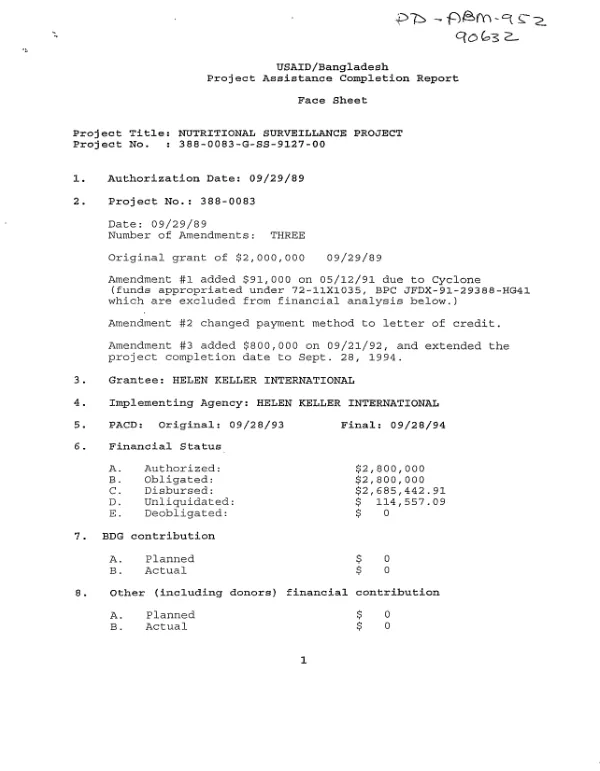
USAID/Bangladesh project assistance completion report : nutritional surveillance project
Sign inUSAID. MISSION TO BANGLADESH
USAID/Bangladesh project assistance completion report : nutritional surveillance project
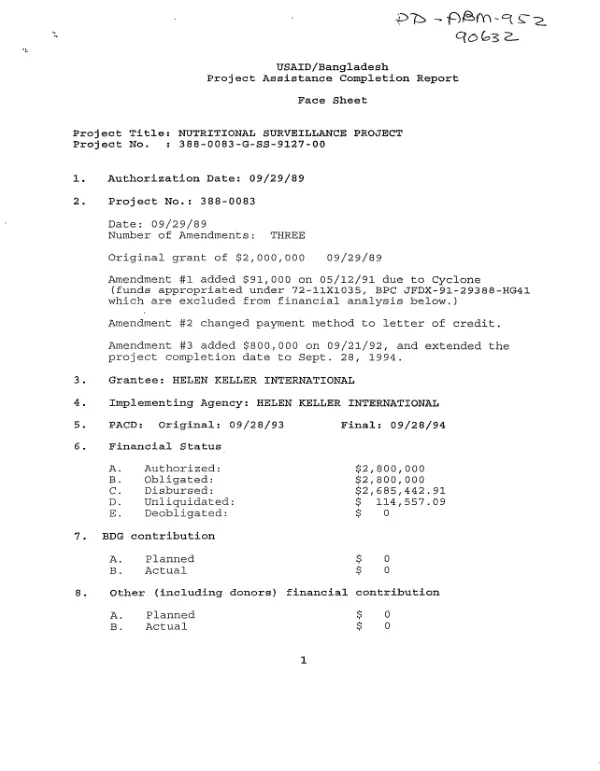
PACR of a project (9/89-9/94) to establish a nutritional/health surveillance system in flood-prone areas of Bangladesh.
1996
Sign in to readA free account is required to download.
Abstract
The project was implemented by Helen Keller International (HKI). The project established in 32 sentinel districts a nutritional surveillance program that compiles data on 11,000 households every 2 months, summarizes and publishes it within 30 days, and distributes it to more than 600 people in government, donor, and NGO organizations. These reports have become widely accepted as a primary source of timely, credible information on nutritional, health, and household welfare status of populations in disaster-prone areas. HKI developed easy-to-use methods and procedures for monitoring nutritional status, which enabled HKI to identify seasonal trends and vulnerable areas. Following the 1991 cyclone, an extension project was organized to monitor the affected areas, and the resulting information was used by the government and donors for resource allocation. The project also published a series of special reports based on its core data. These reports include examinations of the link between nutritional status and the 1991 and 1994 cyclones, the Rohingya refugee camps, seasonality, gender, sex behavior, family planning, child nutrition in female-headed households, and meeting the nutritional goals from the World Summit for Children by the year 2000. The project did not succeed in turning responsibility over to the BDG Institute of Public Health and Nutrition (IPHN). This organization has not gained enough strength within the Ministry to assume additional responsibilities. The probability that the project can be turned over to the Bureau of Statistics during the next few years is not high. If the donor community requires the information that HKI furnishes, then it will most likely have to continue funding the project. The following lessons were learned. (1) Reliable, timely, nationally representative information on health and nutrition is important to USAID/B, UN agencies, other donors, NGOs, and the Government of Bangladesh and helps to allocate resources effectively. (2) Other agencies are willing to provide support to this project, but these contributions have represented less than 7% of the total costs. Strategies to draw on other agencies' resources need to be developed. (3) In January 1994, HKI distributed a readership survey. Most of the 13% who responded gave the usefulness of the reports a favorable rating. Two members of USAID's Agricultural Development Division said the data is of utmost importance to their work, allowing them to track the severity of food shortages during a local drought. This positive response by USAID/B officers is consistent with reports by other user organizations. (4) The project was intended to be an aid in coping with natural disasters. There have been few of these, but the threat of them still exists. Continuation of the project will assure data will be available to relief organizations in the event of a natural disaster.