USAID DEC
USAID Bureau for Democracy, Conflict, and Humanitarian Assistance Annual Report 2014
Sign inUSAID
USAID Bureau for Democracy, Conflict, and Humanitarian Assistance Annual Report 2014
The Bureau for Democracy, Conflict, and Humanitarian Assistance is a key component of the United States Agency for International Development (USAID).
2014 · 12 pages
Sign in to readA free account is required to download.
Abstract
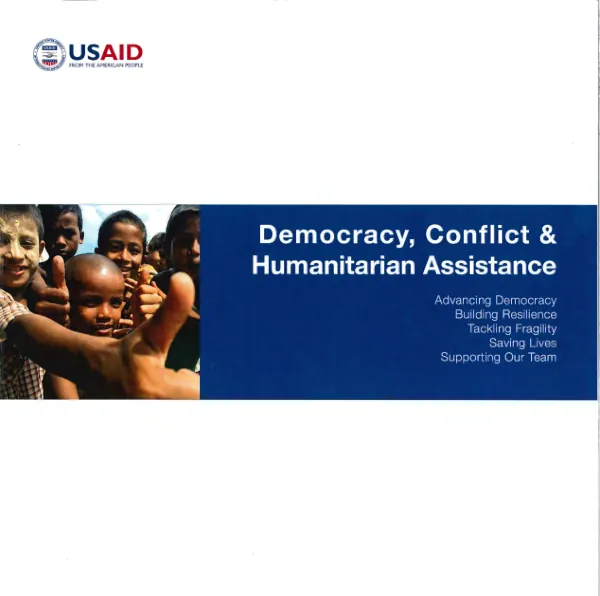
The Bureau's primary objective is to promote democratic and resilient societies that can mitigate disasters and conflicts, and stay on a path toward peace and prosperity. This is achieved by advancing inclusive and accountable democracies, building resilience in areas of recurrent crisis, tackling fragility, saving lives, and supporting USAID's development investments to end extreme poverty. The Bureau has a team of over 800 members across nine offices, with expertise in assessing, designing, and managing programs in difficult and rapidly evolving environments. Technical assistance is provided to local organizations, civil society groups, faith-based organizations, the private sector, and local governments to drive locally led solutions. The Bureau also establishes high-impact partnerships with local organizations to preserve and expand democratic and peaceful space in complex political environments. The Office of U.S. Foreign Disaster Assistance has the Presidential authority to lead and coordinate international humanitarian disaster response on behalf of the U.S. government. In the event of a large-scale disaster, the Office can rapidly deploy a Disaster Assistance Response Team (DART), which draws on expertise across the U.S. government to provide the most timely and effective humanitarian response. The Office also partners with Urban Search-and-Rescue Teams that are on standby to deploy within hours if necessary. The Bureau has early warning systems, including the Famine Early Warning System Network (FEWSNET), which provides early warning on acute food insecurity. Assessment tools are used to measure the risk of armed conflict across countries, informing programs to prevent and respond to crises in a timely manner. Prepositioned commodities, including emergency shelter materials, warm blankets, water treatment systems, and hygiene kits, are stocked in three emergency warehouses overseas and can be transported rapidly to disaster-affected areas around the globe. The Bureau manages innovative mechanisms that foster collaborative and innovative approaches to constantly evolving situations. These include the Rapid Response Program, the International Emergency Food Assistance Annual Program Statement, the SWIFT indefinite quantity contract, the Consortium for Elections and Political Processes Strengthening cooperative agreement, and the Global Civil Society Strengthening cooperative agreement. The Bureau also deploys funds to prevent, respond, recover, and transition from crisis through various accounts, including the International Disaster Assistance account, the Transition Initiatives account, the Elections and Political Processes fund, and the Complex Crises Fund. The Bureau's staff uses innovative analytical frameworks and methodologies to inform programs, including the Strategic Assessment Framework for Democracy and Governance, the Conflict Assessment Framework, the Nongovernmental Organization Sustainability Index and Media Sustainability Index, and the Humanitarian Assessment Framework. The Bureau has nine offices, including the Office of U.S. Foreign Disaster Assistance, the Office of Transition Initiatives, the Office of Food for Peace, the Center of Excellence on Democracy, Human Rights, and Governance, and the Office of Crisis Surge Support Staff.