PALLADIUM INTERNATIONAL, LLC
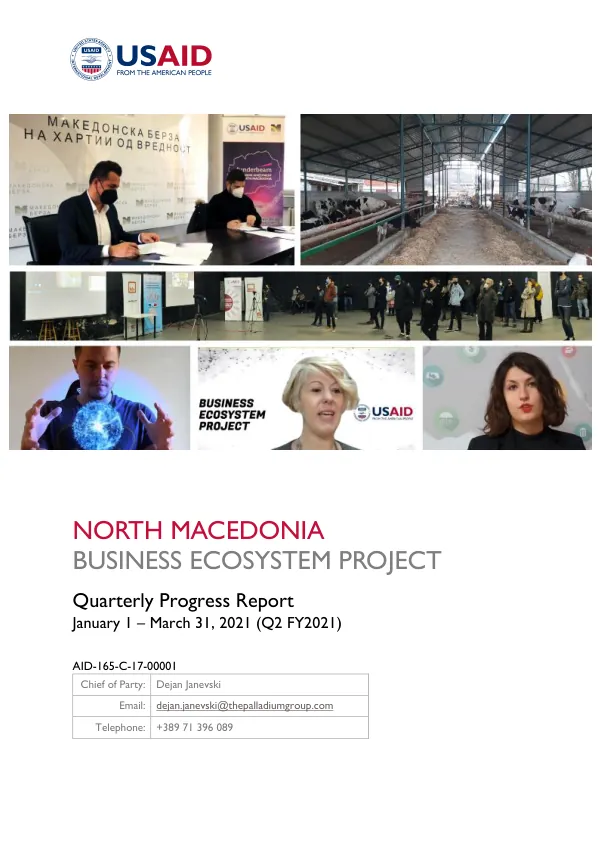
USAID Business Ecosystem Project Quarterly Progress Report (Jan 1 – Mar 31, 2021)
The Business Ecosystem Project (BEP) in North Macedonia is a four-year economic development project implemented by Palladium, with the goal of transforming the competitiveness of micro, small, and medium enterprises (MSMEs) in the country.
2021 · 117 pages
Sign in to readA free account is required to download.
Abstract
The project officially started operating on September 29, 2017, and is set to conclude in September 2021. BEP has three overarching and interlinked objectives: Improved Business Support Organization (BSO) Services to MSMEs, Improved MSMEs' Access to Sources of Financing, and Lead Firms Investing in the Development of Supply Chains and Labor Forces (Private Sector Engagement). BEP aims to generate 15 percent average annual growth rate for MSMEs, resulting in $81.5 million in MSME revenue growth, create 5,750 new jobs, provide access to alternative and traditional financing for 250 MSMEs, facilitate $100 million in financing for MSMEs and startups, and leverage $10 million from lead firm and private sector partners in support of project activities. The project will bring transformative, sustainable change to North Macedonia's business ecosystem at scale within its four-year life of project, paving the way for North Macedonia's market system to continue to function without USAID after BEP has concluded. BEP made impressive strides in the past three years, surpassing several indicator targets while remaining flexible and responsive to the changing needs of the project through its Collaborate, Learn and Adapt (CLA) framework. The project implemented proof-of-concept activities with the private sector in the first two years, developed insights to scale successful initiatives in targeted sectors for Years 3 and 4, and deepened collaboration with both the private and public sector through its integrated approach. Under Objective 1, BEP and Strategic Development Consulting (SDC) continuously worked with BSOs to address challenges imposed by COVID-19, while providing consultation and support to find alternative ways to adapt to the crisis. The project also facilitated inter-BSO networking and partnerships, and implemented grants and technical assistance to BSOs to strengthen their internal capacity and sustainability. Under Objective 2, BEP supported MSMEs to improve their financial literacy, management, and access to finance. The project worked with traditional and alternative financial instruments and with MSMEs to ensure appropriate sources of financing were available and accessible for business expansion efforts. BEP also facilitated access to alternative and traditional financing for 250 MSMEs and leveraged $10 million from lead firm and private sector partners in support of project activities. Under Objective 3, BEP catalyzed lead firms to invest backward in their supply chains, helping suppliers meet standards, improve quality, and introduce new technologies and know-how. The project also facilitated private sector engagement, increasing private sector investment in economic development activities. BEP implemented the Journey to Self-Reliance approach, which aimed to increase private sector investment in economic development activities and leverage $10 million from lead firm and private sector partners in support of project activities. Throughout Q2 of FY4, most of BEP's planned work has been finalized, from processing close-out activities for part of the BSOs, to lobbying for additional Access to Finance (A2F) opportunities, to procurement and installation of equipment in the Private Sector Engagement activities.