CHEMONICS
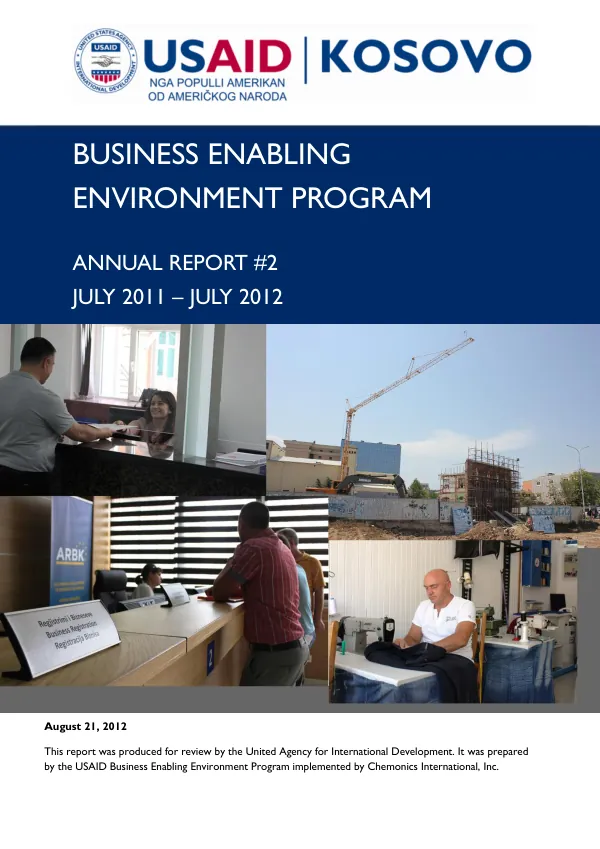
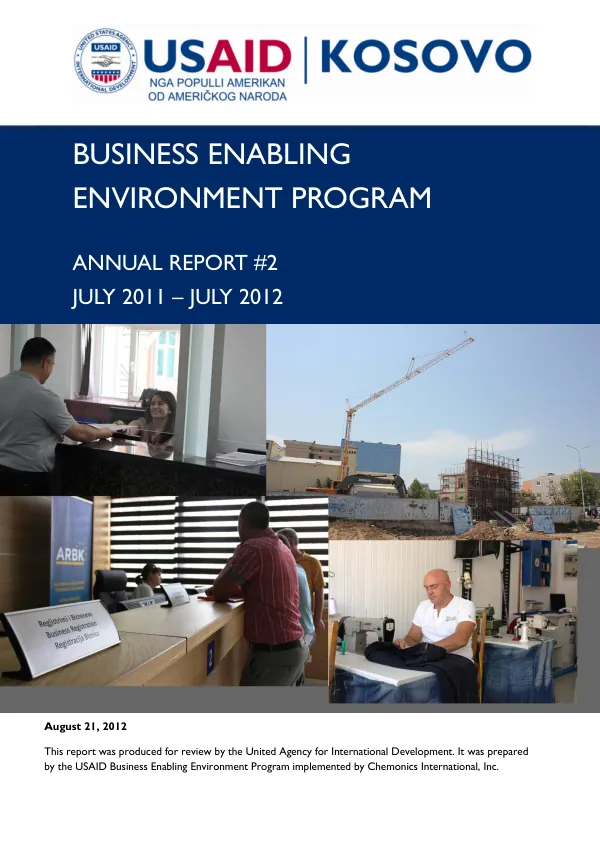
USAID Business Enabling Environment Program Annual Report July 2011 - July 2012
The Business Enabling Environment Program is an innovative three-year initiative by USAID leveraging the successful methodology applied in other countries to use third-party measures of performance to drive cross-cutting reforms, while pursuing holistic strategies taking into account all aspects of the legal environment for economic activity and collaboration with other donors and projects.
2012 · 75 pages
Sign in to readA free account is required to download.
Abstract
This report describes project activity since July 2011 through July 2012, the end of the second contract year. The program's second year activities built on the Government of Kosovo's (GoK) buy-in achieved in the first year, driving transformational business environment reform that unleashes economic potential and impacts the lives of citizens in Kosovo. Leveraging the GoK's commitment to ambitious reform initiatives through its Economic Vision 2014, this year saw impressive results in areas of business startup, construction permitting, national- and municipal-level transparency, international trade, licensing, regulatory harmonization and rationalization, and credit. Transformational reform across a country cannot be accomplished alone. USAID|BEEP has forged crucial relationships with collaborative partners in the public and private sectors and the donor community. Champions of business environment reform proved invaluable in Kosovo's journey to improved economic prosperity, including the Office of the Prime Minister (OPM), the Ministry of Environment and Spatial Planning (MESP), the Ministry of Trade and Industry (MTI), the Central Bank of Kosovo (CBK), and Kosovo Customs. Political willingness to undertake often difficult initiatives remains key to achieving sustained improvement in the business environment. The program's work plan progress report highlights the achievements of Component One: Improved Rules and Regulations. This component focused on supporting municipal reforms through the Municipal Competitiveness Index (MCI) and pursuing opportunities to institutionalize the MCI. The program also supported national business environment improvement through the Doing Business report and non-Doing Business initiatives. Additionally, Component One increased public access to and knowledge of law and legal reforms through the development of law on normative acts and legal information database, and strengthened the Office of the Prime Minister. Component Two: Reduced Barriers to Trade aimed to improve the legal framework for import and export transactions, support streamlined import and export processes, build capacity to institutionalize trade best practice, and develop and publish the International Trade Guide (ITG) to promote trade predictability. Component Three: Reduced Risks of Lending in the Financial Sector focused on reviewing the World Bank's Doing Business report and monitoring performance in the Getting Credit indicator, finalizing the upgrade to the CBK public credit registry, and supporting legal, regulatory, and informational reform in the financial sector. Component Four: More Transparent Tenders aimed to increase transparency in the tendering process. The program's results are reflected in the Doing Business rankings, which show Kosovo's ranking improving from 133rd to 112th in the ease of doing business. The Municipal Competitiveness Index (MCI) also showed significant improvement, with a 27% increase in the index score. The program's economic impact is evident in the increased household income among program participants, which rose by 27% compared to the control group. The program's achievements in reducing barriers to trade, reducing risks of lending in the financial sector, and increasing transparency in the tendering process have contributed to Kosovo's improved business environment.