CHEMONICS
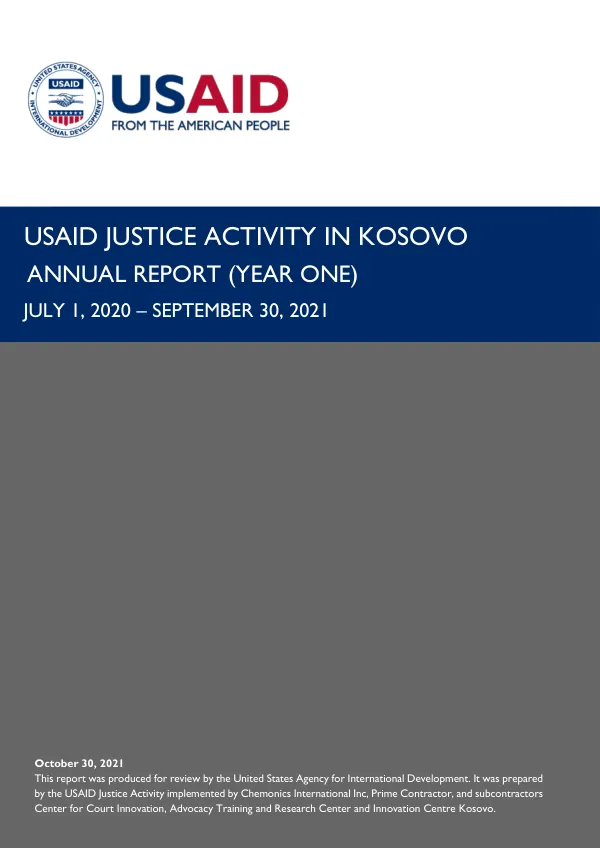
USAID Justice Activity in Kosovo Annual Report (Year One)
Rule of Law development in Kosovo has made strides in the 20 years since the war ended.
2021 · 43 pages
Sign in to readA free account is required to download.
Abstract
The U.S. Government and the U.S. Agency for International Development have taken a lead role in strengthening rule of law, with a focus on justice sector efficiency and capacity building, with increasingly greater emphasis on supporting Kosovo's journey to improved governance and self-reliance. Strong progress has been made in strengthening Kosovo's legal framework and improving the performance and capacity of its justice institutions, the main ones being the Kosovo Judicial Council (KJC), the Kosovo Prosecutorial Council (KPC), and the Ministry of Justice. Further notable judicial reforms have unified courts, improved the management of court backlogs, and established a free legal aid system. The Government of Kosovo approved a comprehensive Rule of Law Strategy on August 11, 2021, which outlines a vision and path forward to continually improve, meeting reform goals outlined as part of Kosovo's Instrument for Pre-Accession Assistance (IPA) with the European Union. The Strategy focuses on increased capacity and professionalism of judges and court staff, improved efficiency of courts, and greater accountability to citizens through trust building engagement. However, ongoing problems with political interference, efficiency, accountability, and professionalism, as well as the prioritization of institutional reforms over attention to fundamental rights, mean that the justice system still struggles to effectively deliver justice services to the citizens it is mandated to serve. The judiciary experienced setbacks in the past year due to an influx of new pandemic-related cases, which increased the courts' caseload by approximately 230 percent. A phenomenon in the trends of new case-inflow in the last two years, specifically in the civil area, has been on the rise, with a noticeable increase in lawsuits related to collective agreements for meals and jubilee wages. This has made a big difference in the final performance and overall efficiency of the Basic Courts in achieving or continuing the positive trend from the previous years. Additionally, a new government intent on reforms designed to root out corruption has turned a critical eye on the KJC and KPC, creating fragmentation when partnership in problem-solving should be the goal. Despite these challenges, Kosovo's overall score in the 2021 World Justice Project Index improved slightly over its 2020 debut rating. The latest edition of the UNDP Public Pulse Poll reports a significant increase in public perception of the judiciary, registering at 34.6 percent as of May 2021, over averages of 16.1 percent and 23.9 percent in 2019 and 2020, respectively. This change presents an incentive to reflect on those key elements that have led to this change and use them to motivate continual forward progress by the judiciary and its donor-funded implementing partners. The KJC's new Chair is decisive, fast-acting, and results-oriented, which is needed to drive quality administration of justice. Having assumed the post this past July for a five-year term, the Chair quickly set a new management tone – one that demands excellence and accountability of the Council as well as judges and court staff. The Chair is also a staunch advocate for the judiciary's independence, but his approach in working with other institutions is constructive and inclusive, which bodes well for avoiding impasse. The above blend of challenges and opportunities presents an environment ripe for advancing key reforms, such as critically linked judge performance evaluation with court performance metrics, meaningful justice institutions' outreach and engagement with citizens, and increasing access to justice through multiple pathways. Justice Activity has and will continue to play a key role in strengthening Kosovo's justice institutions, with primary attention dedicated to assisting the KJC, its key Committees (Court Administration, Training, Normative), the Assembly of Court Presidents and Supervisory Judges (ACPSJ) the courts, and the KJC Secretariat (IT Unit). Evidence collected through Justice Activity's applied political economy analysis (APEA) confirmed that average citizens in Kosovo still lack sufficient knowledge about the judiciary, other justice providers, and the types of services they can access. We also received anecdotal information that citizens are unclear about how to navigate the courts once there. Closing the justice gap in Kosovo will require concerted awareness building effort as well as capacity building of justice institutions to make sure they have the resources and systems to effectively address citizen concerns.