DELOITTE CONSULTING, LLP
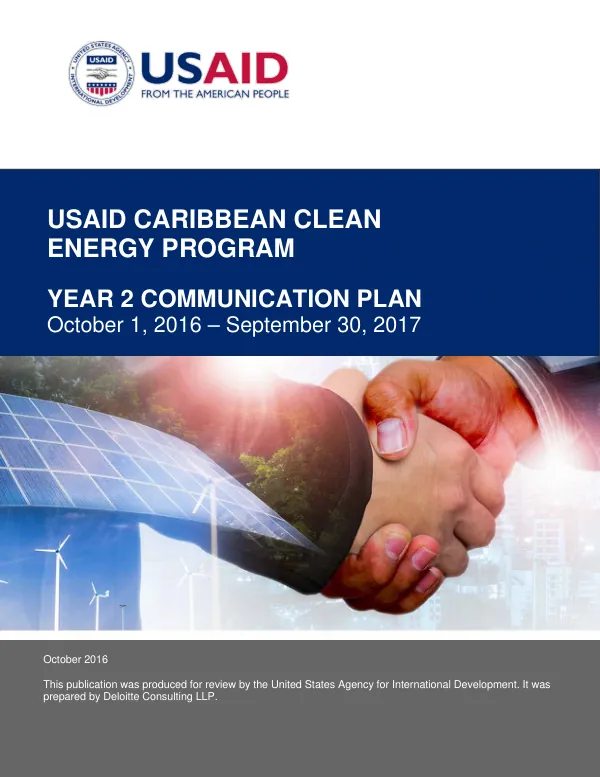
USAID CARCEP Communication Plan
The USAID Caribbean Clean Energy Program (USAID CARCEP) is a five-year development activity funded by the United States Agency for International Development (USAID).
2016 · 20 pages
Sign in to readA free account is required to download.
Abstract
The program aims to establish effective policy, legislative, and regulatory environments for energy efficiency and low-emission growth in the energy sector in the Caribbean region. USAID CARCEP works closely with the private sector to drive investments in clean energy development and focuses on eight beneficiary countries: Antigua and Barbuda, Barbados, Dominica, Grenada, Jamaica, St. Kitts and Nevis, St. Lucia, and St. Vincent and the Grenadines. The program focuses on five major tasks: improving the enabling environment for clean energy development, optimizing variable renewable energy integration, accelerating private sector clean energy investment, energy efficiency benchmarking in the hotel and tourism sector, and coordination and promotion of USAID and United States Government (USG) inter-agency activities in the energy sector and sharing lessons learned with other island nations. A strategic communication framework is necessary to promote USG, USAID, and USAID CARCEP activities at the national and regional level, with specific activities for each of the components and promotion requirements to ensure effectiveness as the program proceeds into Year 2. The communication plan aims to ensure the development and strategic promotion of programmatic information and activities that will optimize visibility to all stakeholders and aid in achieving the program's development objectives under Tasks 1-5. The key communication objectives for USAID CARCEP in Year 2 are awareness building, visibility, online engagement, and internal communication. Effective communication is critical to the program's success, and the communication team will utilize creative and replicable methods of delivering critical messages, program activity highlights, and success stories to the select audiences categorized below. The communication team will address specific questions to increase understanding of the audience, including who the stakeholders are, what their needs and interests are, what needs to be communicated with each stakeholder and why, how the messages will be effectively delivered, and in what timeframe. The communication plan defines who will receive the communication, what information will be communicated, how the communication will be delivered, who communicates, and the frequency of communication. The program will utilize a stakeholder communication matrix to categorize audiences and develop targeted communication strategies. The matrix categorizes stakeholders into key partners, local partners, wider stakeholders, government ministries, regulators, and other agencies, women-in-energy groups, media, USAID and other USG and non-USG donor agencies, youth-in-energy groups, the hotel and tourism sector, regional audience, electricity utility companies, international community, private sector businesses, research institutions, clean energy NGOs, financial institutions, and USAID CARCEP staff. The communication plan emphasizes the importance of effective communication in driving adoption of best-practices and fostering growth in energy efficiency and renewable energy in the Caribbean. The program will continue to provide technical assistance in support of regulatory reform conducive to clean energy development, provide technical tools and resources to address energy efficiency barriers, and provide technical support towards addressing renewable energy integration issues.
Related documents