GLOBAL FUND
USAID|Central America Capacity Project Annual Report Fiscal Year 2017
The USAID | Central America Capacity Project implemented activities in El Salvador, Guatemala, Honduras, and Panama under the Cooperative Agreement No.
2016 · 51 pages
Sign in to readA free account is required to download.
Abstract
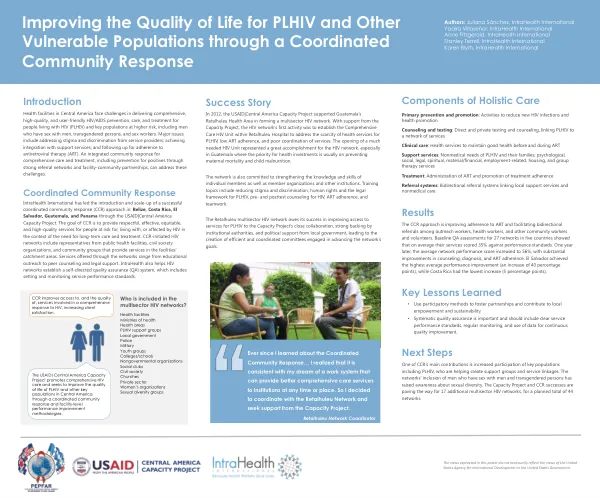
AID-596-LA-00001 for fiscal year 2017. The project focused on strengthening the quality of care and improving the quality of life for people living with HIV and other vulnerable populations. The project's work plan and Cooperative Agreement components were developed in accordance with the Comprehensive and Continuous Care framework, which includes Optimizing Performance and Quality (OPQ), Coordinated Community Response (CCR), and Nosocomial Infection Prevention. The project provided technical assistance (TA) to 37 hospitals and HIV care units, 32 health centers, and 15 multisector networks. TA included strengthening the counterparts' capacity to implement OPQ, follow up on Healthcare Associated Infections (HAI), develop in-service and pre-service staff competencies in HIV and bio-safety related topics, and create strategies to strengthen adherence to antiretroviral treatment (ART) in the four countries. During fiscal year 2017, partnerships continued with projects from the Global Fund, the Pan American Health Organization (PAHO), the United Nations Program on HIV/AIDS (UNAIDS), the Regional and Country Coordination Mechanisms, and the Council of Ministers of Health of Central America (COMISCA) to drive strategies under a common vision of 90-90-90 goals. The project assured institutionalization of country-specific versions of the quality improvement process in three out of the four countries: Continuous Quality Improvement in El Salvador, Supportive Supervision in Honduras, and OPQ in Panama. The project worked with the National HIV Programs in El Salvador, Guatemala, and Panama to complete the national reports on the 2015 HIV Continuum of Care Cascade. The 2016 reports are currently in progress and will include an analysis of the patients' immunological status at the time of starting treatment. Results from these reports were shared with all countries, and national intervention plans were developed in all four countries aimed at closing gaps identified for each cascade pillar. The multisector networks achieved closer coordination with health services, inclusion of key populations (KP) in all networks, and better coordination to improve the situation of people living with HIV, men who have sex with men (MSM), and transgender women. Across the region, a total of 1,797 people were trained in OPQ, learning for performance (LFP), biosafety, stigma and discrimination, and adherence. Training participants developed competencies in the identification and prevention of stigma and discrimination, positive health, with dignity and prevention, and adherence to ART in the four countries. The project continued supporting HIV care units in retention and recovery of treatment dropouts and those patients at risk of dropping through adherence promoters (AP) in the care units and community liaisons (CL) who perform home visits to facilitate patients' return to treatment. A total of 4,001 people at risk of dropout were retained by the adherence promoters, 73 percent of all potential dropouts identified and contacted; and 932 people who already had dropped out returned to the care unit after being located through phone calls from the adherence promoter, 50 percent of those contacted. The Community Liaisons (CL) recovered 982 dropouts through home visits. The project's achievements in multisector networks included closer coordination with health services, inclusion of key populations in all networks, and better coordination to improve the situation of people living with HIV, men who have sex with men (MSM), and transgender women. The project's training program reached a total of 1,797 people, who developed competencies in OPQ, LFP, biosafety, stigma and discrimination, and adherence. The project's support for HIV care units in retention and recovery of treatment dropouts and those patients at risk of dropping resulted in the retention of 4,001 people at risk of dropout, 73 percent of all potential dropouts identified and contacted; and the return of 932 people who already had dropped out to the care unit after being located through phone calls from the adherence promoter, 50 percent of those contacted. The Community Liaisons (CL) recovered 982 dropouts through home visits. The project's achievements in the four countries included the institutionalization of country-specific versions of the quality improvement process in three out of the four countries, completion of national reports on the 2015 HIV Continuum of Care Cascade, and development of national intervention plans aimed at closing gaps identified for each cascade pillar. The project's partnerships with international organizations and national HIV programs contributed to the achievement of the 90-90-90 goals.