USAID DEC
Improving the Quality of Life for PLHIV and Other Vulnerable Populations through a Coordinated Community Response
Sign inINTRAHEALTH
Improving the Quality of Life for PLHIV and Other Vulnerable Populations through a Coordinated Community Response
Improving the Quality of Life for PLHIV and Other Vulnerable Populations through a Coordinated Community Response Health facilities in Central America face challenges in delivering comprehensive, high-quality, and user-friendly HIV/AIDS prevention, care, and treatment for people living with HIV (PLHIV) and key populations at higher risk, including men who have sex with men, transgendered persons, and sex workers.
2016 · 1 pages
Sign in to readA free account is required to download.
Abstract
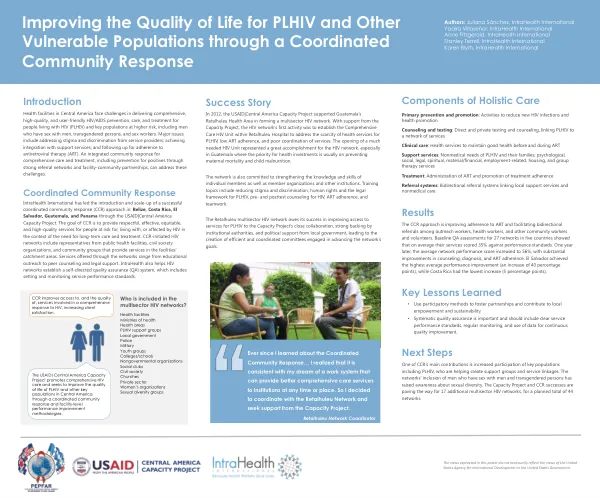
Major issues include addressing stigma and discrimination from service providers; achieving integration with support services; and following up for adherence to antiretroviral therapy (ART). An integrated community response for comprehensive care and treatment, including prevention for positives through strong referral networks and facility-community partnerships, can address these challenges. IntraHealth International has led the introduction and scale-up of a successful coordinated community response (CCR) approach in Belize, Costa Rica, El Salvador, Guatemala, and Panama through the USAID|Central America Capacity Project. The goal of CCR is to provide respectful, effective, equitable, and high-quality services for people at risk for, living with, or affected by HIV in the context of the need for long-term care and treatment. CCR-initiated HIV networks include representatives from public health facilities, civil society organizations, and community groups that provide services in the facilities' catchment areas. Services offered through the networks range from educational outreach to peer counseling and legal support. IntraHealth also helps HIV networks establish a self-directed quality assurance (QA) system, which includes setting and monitoring service performance standards. The CCR approach has shown significant improvements in adherence to ART and facilitating bidirectional referrals among outreach workers, health workers, and other community workers and volunteers. Baseline QA assessments for 27 networks in five countries showed that on average their services scored 35% against performance standards. One year later, the average network performance score increased to 56%, with substantial improvements in counseling, diagnosis, and ART adherence. El Salvador achieved the highest average performance improvement (an increase of 40 percentage points), while Costa Rica had the lowest increase (5 percentage points). Key components of holistic care under the CCR approach include primary prevention and promotion, counseling and testing, clinical care, support services, treatment, and referral systems. The approach emphasizes the importance of participatory methods to foster partnerships and contribute to local empowerment and sustainability. Systematic quality assurance is also crucial, including clear service performance standards, regular monitoring, and use of data for continuous quality improvement. The multisector HIV networks established under the CCR approach include a diverse range of stakeholders, including health facilities, ministries of health, health areas, PLHIV support groups, local government, police, military, youth groups, colleges/schools, nongovernmental organizations, social clubs, civil society, churches, private sector, women's organizations, and sexual diversity groups. The networks' inclusion of men who have sex with men and transgendered persons has raised awareness about sexual diversity, and the approach has improved access to, and the quality of, services involved in a comprehensive response to HIV, increasing client satisfaction.