INTERNATIONAL RESCUE COMMITTEE
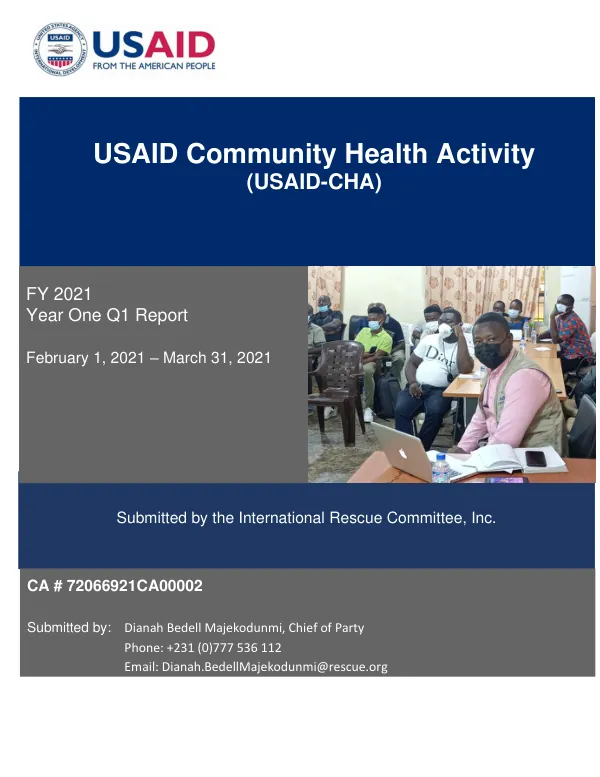
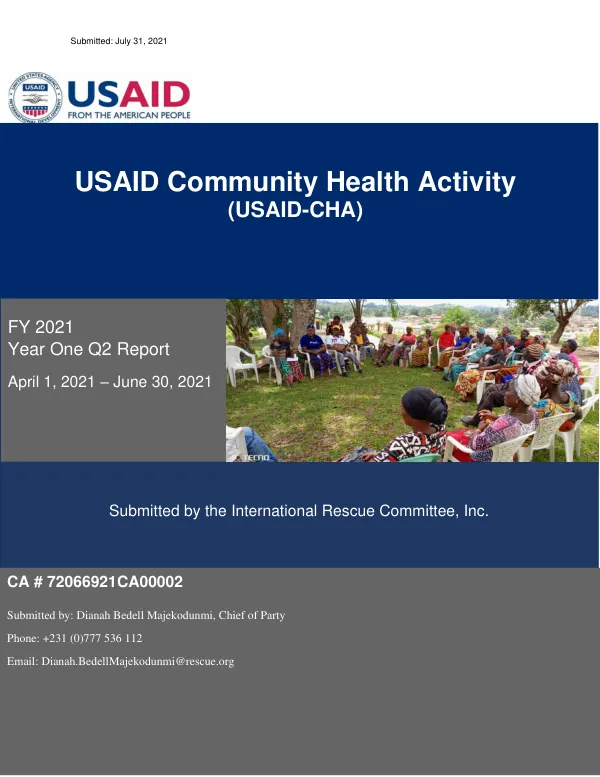
USAID Community Health Activity Quarterly Report: April 1, 2021 – June 30, 2021
The USAID Community Health Activity is a project designed to strengthen the Liberian community health system.
2021 · 34 pages
Sign in to readA free account is required to download.
Abstract
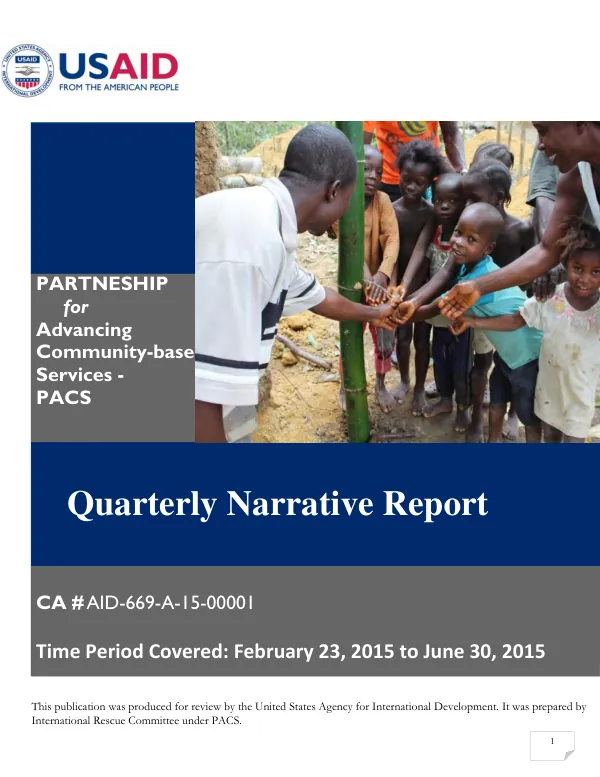
The project aims to increase the coverage of Community Health Assistants (CHA) in underserved districts, improve the capacity of CHAs to deliver quality health services, and strengthen county health teams and communities' capacity to plan, manage, and monitor health services. The project is implemented in Bong, Lofa, River-Gee, and Grand Kru counties by a consortium of local and international organizations, including the International Rescue Committee (IRC), Last Mile Health (LMH), and three national partners. The project is informed by a thorough analysis of the sector, lessons learned from implementing the USAID Partnership for Advancing Community-Based Services (PACS), and consultation with the Ministry of Health (MOH), County Health Teams, and civil society organizations. The project has identified four key principles to achieve its goals: prioritizing client voices and choices, promoting gender equality, improving data collection and quality, and achieving sustainable results for self-reliance. The project's objectives are to increase the coverage of CHAs to population ratio in underserved districts and communities, improve the quality of health services through trained, supervised, and motivated CHAs, and enhance the capacity of county health teams and communities to plan, manage, and monitor health services. The project's results include increased coverage of NCHAP to ensure access to remote areas, improved quality of community health services, and enhanced capacity of county health teams and communities to plan, manage, and monitor health services. The project has made significant progress in achieving its objectives. In the second quarter of 2021, the project mobilized and coordinated with Community Health Committees (CHCs) to select CHAs, trained CHSSs and CHAs using NCHAP curriculum and training methodology, equipped and deployed CHAs to communities to provide health services, and supported the payment of CHAs and CHSSs in all districts. The project also provided technical assistance to the Ministry of Health's Community Health Services Division (CHSD) to improve the recruitment and retention of a gender-balanced NCHAP workforce. The project's results also include improved quality of community health services, with CHAs delivering quality health services to communities living more than 5km from a health facility. The project has also improved supportive supervision and coaching for CHAs, improved two-way referral systems, and contributed to improved planning and accountability for CHA commodities. Additionally, the project has fostered an enabling environment to support communities in carrying out best practices to prevent and treat disease. The project has also strengthened county health teams' and communities' capacity to plan, manage, and monitor health services. The project has provided technical assistance to develop a transition strategy for increased financial responsibility of NCHAP, provided targeted capacity building support for planning and implementation of NCHAP, and strengthened the capacity of county health teams and civil society organizations to promote local ownership of NCHAP. The project's indicator performance shows significant progress in achieving its objectives. The project has increased the coverage of NCHAP to ensure access to remote areas, improved the quality of community health services, and enhanced the capacity of county health teams and communities to plan, manage, and monitor health services. The project's cross-cutting issues, including partnership coordination, gender mainstreaming, and sustainability, have also been addressed. The project's financial update shows that the project has made significant progress in achieving its objectives. The project has received funding from USAID and has made significant expenditures on personnel, training, and equipment. The project's annexes include success stories and photos that demonstrate the project's impact and achievements.