INTERNATIONAL RESCUE COMMITTEE
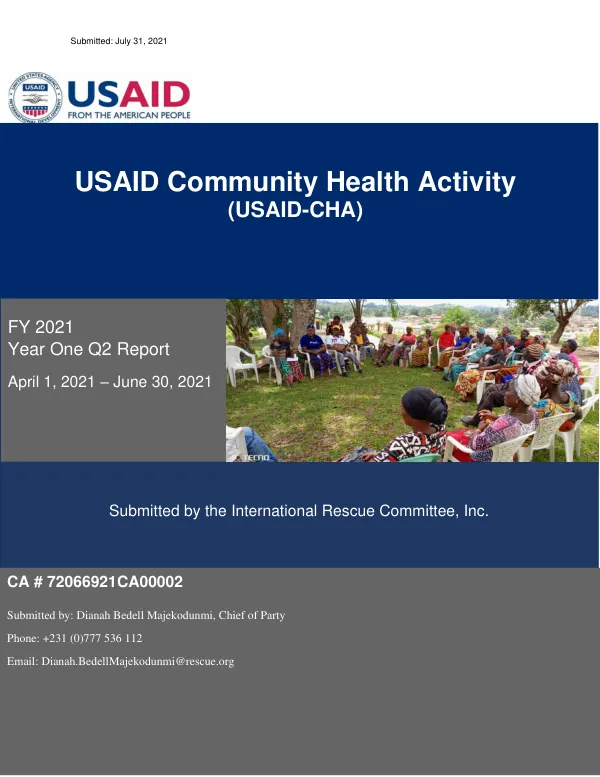
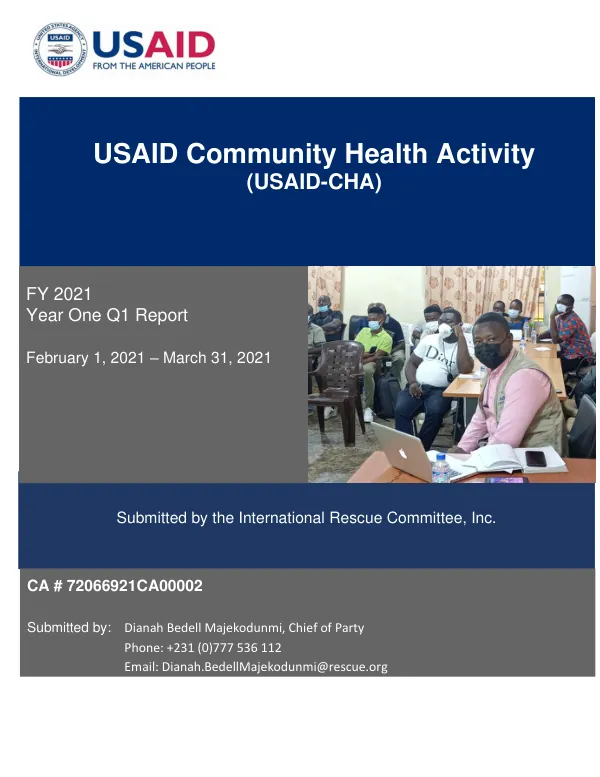
USAID Community Health Activity (USAID-CHA) Year One Q1 Report
The USAID Community Health Activity (USAID CHA) aims to strengthen the Liberian community health system by increasing the coverage of Community Health Assistants (CHA) in underserved districts, improving the capacity of CHAs to deliver quality health services, and enhancing the capacity of county health teams and communities to plan, manage, and monitor health services.
2021 · 22 pages
Sign in to readA free account is required to download.
Abstract
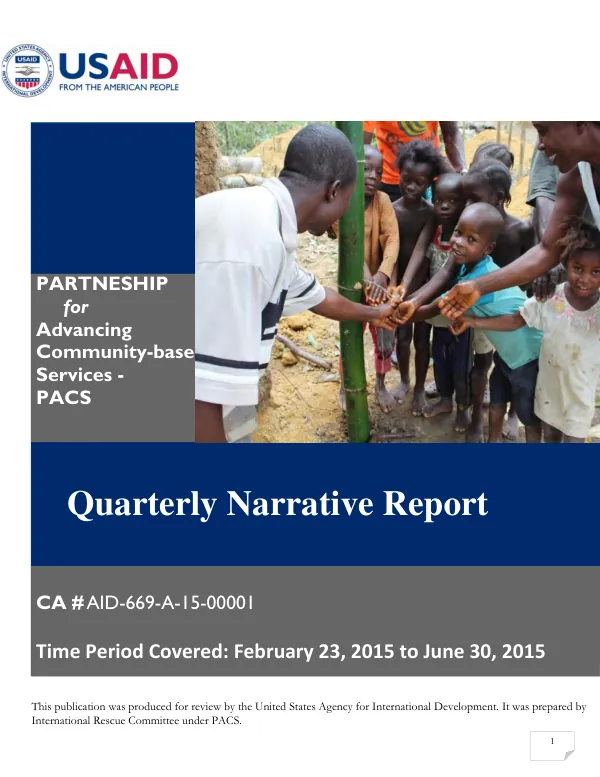
The project is designed to transfer ownership to the Government of Liberia, with a focus on sustainability and self-reliance. The project is implemented by a comprehensive partnership between the International Rescue Committee, Inc. (IRC), Last Mile Health (LMH), Community Safety Initiative (CSI), Development Education Network of Liberia (DEN-L), and EQUIP Liberia. This partnership brings together global expertise in strengthening community health systems and a deep understanding of the Liberian health system, key actors, and local realities. The project design has been informed by a thorough analysis of the sector, lessons learned from implementing the USAID Partnership for Advancing Community-based Services (PACS), and consultation with the Ministry of Health (MOH), county health teams, and CHAs. The project is guided by four key principles: prioritizing client voices and choices, promoting gender equality, improving data collection and quality, and achieving sustainable results for self-reliance. To operationalize these principles, the project has developed a flexible, adaptive management approach designed to foster collaboration, learning, and adaptation (CLA) at all levels. This approach is core to the project's strategy for achieving its objectives and expected results. Objective 1 of the project focuses on increasing the coverage of CHAs to the population ratio in underserved districts and communities in the three counties. Result 1.1 aims to increase the coverage of National Community Health Assistant Program (NCHAP) to ensure access to remote areas in underserved districts and communities in the three counties. This has been achieved through the recruitment and training of CHAs, as well as the establishment of demonstration plots to showcase the effectiveness of NCHAP. Objective 2 aims to improve the quality of health services through trained, supervised, and motivated CHAs. Result 2.1 focuses on CHAs delivering quality health services to communities living more than 5km from a health facility. This has been achieved through the provision of training and supervision to CHAs, as well as the establishment of community health committees to support the delivery of health services. Objective 3 focuses on enhancing the capacity of county health teams and communities to plan, manage, and monitor health services. Result 3.1 aims to engage county health teams and communities in the planning and management of community health services. This has been achieved through the establishment of county health teams and the provision of training and support to community health committees. The project has made significant progress in achieving its objectives and expected results. The coverage of CHAs has increased, and the quality of health services has improved. The project has also strengthened the capacity of county health teams and communities to plan, manage, and monitor health services. However, challenges remain, including the need to improve data collection and quality, as well as to achieve sustainable results for self-reliance. The project has established a number of partnerships with key stakeholders, including the Ministry of Health, county health teams, and civil society organizations. These partnerships have been critical to the project's success, providing access to expertise, resources, and networks that have enabled the project to achieve its objectives. The project has also established a number of mechanisms for monitoring and evaluation, including the use of data collection tools and the establishment of a monitoring and evaluation committee. Overall, the USAID Community Health Activity has made significant progress in strengthening the Liberian community health system. The project has increased the coverage of CHAs, improved the quality of health services, and enhanced the capacity of county health teams and communities to plan, manage, and monitor health services. However, challenges remain, and the project will continue to work towards achieving its objectives and expected results.