USAID
USAID-COMPETE PARTNER FUNDING SUPPORT TO EAGC MONTHLY REPORT FOR DECEMBER 2012
Eastern Africa Grain Council (EAGC) implemented activities under USAID-COMPETE funding support in December 2012.
2012 · 4 pages
Sign in to readA free account is required to download.
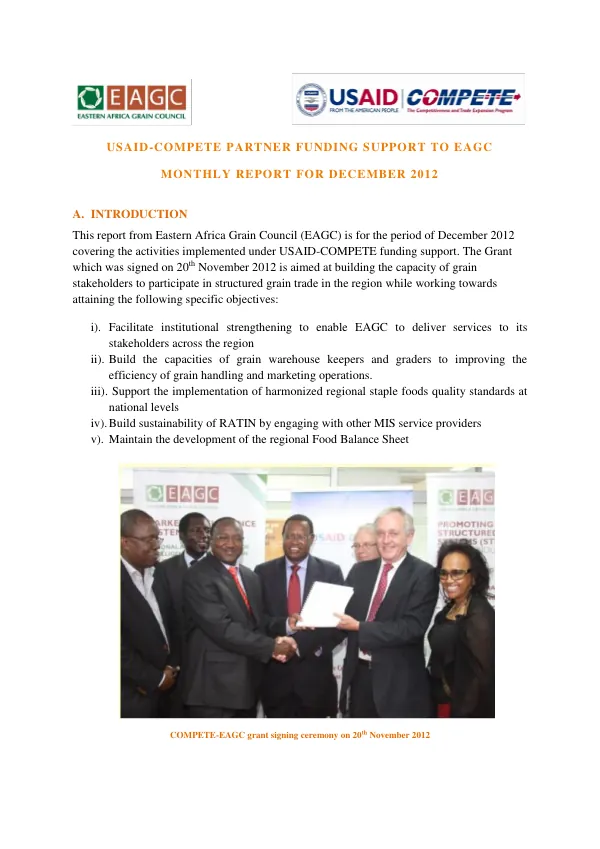
Abstract
The grant aimed to build the capacity of grain stakeholders to participate in structured grain trade in the region. Key objectives included institutional strengthening, building capacities of grain warehouse keepers and graders, implementing harmonized regional staple foods quality standards, and maintaining the development of the regional Food Balance Sheet. EAGC recruited 4 new members during the month, bringing the total number of members to 114. The new members were from Tanzania and Uganda, including Pembe Flour Mills Ltd, Agasha Group Ltd, Elshaday Ltd, and Pura Organic Agrotech Ltd. EAGC co-hosted the East Africa Agricultural Value Chain Investment Summit in Kampala, Uganda, which was attended by over 100 delegates from Uganda, the Eastern Africa region, Europe, and Asia. The summit discussed topics such as grain sector investment opportunities, agricultural production in East Africa, and lessons from India's food export success. Structured Trading Systems (STS) activities included revising the Second Edition of the EAGC STS Handbook. The editor revised and edited manuscripts prepared by authors, and a revised copy was circulated for a second review. Preparations were underway for training warehouse operators and graders in Uganda and Tanzania, with course content, invitation letters, and registration forms developed. Lists of potential warehouses were generated, and invitations would be sent in early January 2013. It was anticipated that at least 30 warehouse operators would be trained per country. Market Information Systems (MIS) activities included engaging market and borders monitors to collect daily information, which was relayed to RATIN for analysis and developing market reports. A template for weekly reporting was developed to improve the quality of reporting and analysis. The Regional Food Balance Sheet (NFBS) tracker for Rwanda, Tanzania, and Uganda was developed, showing potential private sector contributors and their engagement status. Regional Real Time Warehouse Volume Tracking (RTVT) was intended to be rolled out to 12 warehouses in the region, with a mobile application developed to track real-time volumes and train warehouse operators on data transmission. Eight market monitors were engaged to support data collection at market and border points in the region, and they were trained on data collection, transmission, and weekly report compilation.