DEVELOPMENT ALTERNATIVES, INC./FINNET
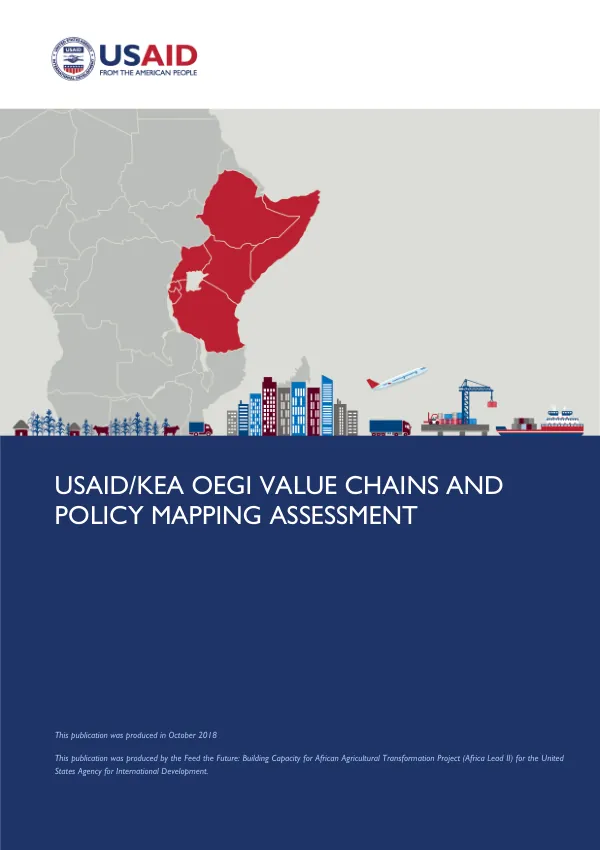
USAID/KEA OEGI Value Chains and Policy Mapping Assessment Report
The USAID/KEA Office of Economic Growth and Integration (OEGI) integrates the objectives of U.S.
2018 · 65 pages
Sign in to readA free account is required to download.
Abstract
Feed the Future (FTF) and the U.S. Government's global hunger and food security initiative to realize its goal of alleviating global hunger. Their initiatives focus on two key related priority areas: agriculture and food security, and economic growth and trade. Under the auspices of the FTF, OEGI works toward improving increased production and productivity of key staple foods and animal products, as well as access to markets by smallholder producers and vulnerable pastoral communities. Working with other development agencies in support of country and regional policy priorities, the OEGI is actively involved in assisting Regional Intergovernmental Organizations (RIGOs) to enact and implement policies that promote regional trade and integration. In May 2018, USAID/KEA OEGI brought together USAID representatives from eight bilateral and regional missions, development partners, RIGOs, national governments, and private sector representatives to discuss how to improve communication, collaboration, and learning among regional and bilateral stakeholders. Following the conference, OEGI requested that Africa Lead undertake a rapid activity assessment on USAID regional and bilateral missions' specific value chains and policy priorities in East Africa. The assessment's scope included bilateral USAID missions (Burundi, Ethiopia, Kenya, Rwanda, Somalia, South Sudan, Tanzania, and Uganda), USAID/KEA, East Africa Trade and Investment Hub (EATIH), three RIGOs, and several other regional institutions. Methodologically, the assessment included a desk review of key regional USAID and FTF food strategy documents, as well as additional external documents; case studies on both value chains and regional trade/policy issues; and key informant interviews with 16 missions and regional institutions. The report highlights the region's background with a variety of pertinent issues to set the scene for the subsequent findings. These include food security regarding vulnerability to climate, challenges in production, barriers to trade, and a lack of quantifiable data in the formal realm. Regional integration for agriculture is also a key issue, with intergovernmental organizations and laws existing but not being institutionalized or fully domesticated. Barriers to trade in agriculture still exist despite efforts to liberalize regional trade, and political economy aspects, including the role of informal institutions and trade, are crucial issues salient within communities that can inhibit economic integration and regional trade. Value chain mapping was conducted to identify common value chains and policies, and to map out the common and priority value chains, policies, and programs (interventions). The assessment identified collaboration opportunities, including gaps and mechanisms to strengthen collaboration between USAID/KEA, bilateral missions, and RIGOs. Country Engagement Plans (CEPs) were reviewed to identify priorities, activities, resources, timelines, and opportunities for collaboration. The assessment found that the region faces significant challenges in achieving food security and promoting regional trade and integration. However, there are also opportunities for collaboration and strengthening of regional institutions to address these challenges. The report provides recommendations for USAID/KEA, bilateral missions, and RIGOs to improve communication, collaboration, and learning among regional and bilateral stakeholders, and to strengthen regional institutions to promote regional trade and integration. The assessment's findings and recommendations are intended to inform USAID/KEA's and bilateral missions' strategies and programs in East Africa, and to contribute to the development of a regional trade and integration agenda that addresses the needs and priorities of the region. The report highlights the importance of collaboration and coordination among regional and bilateral stakeholders to achieve the region's development goals and to promote regional trade and integration.
Related documents