USAID DEC
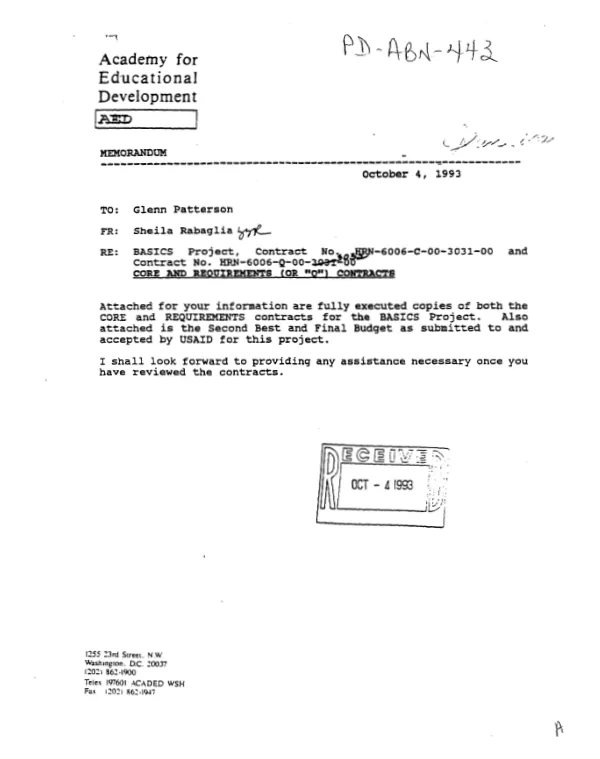
USAID contract nos. HRN-6006-C-00-3031-00 and HRN-6006-Q-00-3032-00 with the Partnership for Child Health Care, Inc. to implement the basic support for institutionalizing child survival project (BASICS)
Sign inUSAID. BUR. FOR GLOBAL PROGRAMS, FIELD SUPPORT, AND RESEARCH. OFC. OF HEALTH, POPULATION, AND NUTRITION
USAID contract nos. HRN-6006-C-00-3031-00 and HRN-6006-Q-00-3032-00 with the Partnership for Child Health Care, Inc. to implement the basic support for institutionalizing child survival project (BASICS)
Project to institutionalize the delivery of child survival (CS) interventions, principally immunization and prevention and treatment of diarrheal diseases, acute respiratory infections (ARI), and malaria in developing countries.
1993
Sign in to readA free account is required to download.
Abstract
The contractor, a consortium of Academy for Educational Development (AED), Management Sciences for Health (MSH), and John Snow Inc. (JSI), will undertake 6 components: TA; human resource development; information dissemination; practical research; a focused small grants program; and limited commodities and cost support. Under the first component, the contractor will (1) provide long-term TA in approximately 15 countries each year. This assistance will include development of a Country Activity Plan (CAP) and the provision of a resident country advisor to help participating countries plan and implement CS interventions; improve or integrate CS delivery systems; increase private sector participation in CS delivery; develop training, conferences, and workshops; design and implement surveys and operations research on CS; plan and implement information, education, and communication (IEC) and marketing activities related to CS activities; assess country and local policies related to child health and child health services; and provide policy dialogue support. (2) The contractor will offer periodic TA to smaller countries and to countries with small CS programs (in which a resident advisor would not be cost-effective) and to countries that already have the institutional and technical capacity to oversee their own programs. An average of 6 countries will be assisted each year. (3) Short-term TA (up to 3 months in duration) will be offered in response to requests by a mission, Ministries of Health, PVOs, or other organization that need such supplementary assistance to plan or implement a CS activity. (4) Regional advisors will be provided to support long-term and periodic country programs, coordinate and oversee contract activities in countries without resident advisors, and help country advisors. The TA component is expected to expend 40% of its resources in Africa, 20% in the Newly Independent States, and 10% each in Central America and the Caribbean, South America, Asia, and the Near East. The second component will provide training to primarily mid-level CS personnel through (1) in-country training, to include training of trainers; (2) training in regional institutions for primarily project implementors and managers; and (3) short, non-degree courses in U.S. institutions. For long-term and or periodic TA programs, the contractor will develop a training plan as part of the country activity plan. Under the third component, the project will: (1) produce manuals and guides presenting the technologies and methodologies derived from contract activities on such topics as systematic approaches to integrating elements of CS programs, curricula and training development for health workers, delivery of CS services in high risk settings, nutritional management of child illnesses, and avoidance and management of antimicrobial resistance in relation to an important child illness; (2) document and disseminate project experience through mailings, information exchange workshops, and publication of issue papers, case studies, field notes, journal articles, etc; (3) establish a CS information center; and (4) host international, regional, and local conferences and workshops in the areas of CS and child health. The fourth component will undertake operations research, model projects, and surveys in areas in which the application of current knowledge through TA is not sufficient to address program needs, or where existing information-gathering activities are inadequate to guide or assess contract activities. These activities will aim to address immediate management and program design decisions rather than produce traditional academic studies and will explore topics such as improving supervisor performance in problem solving, reducing missed opportunities for vaccination, and comparing cost recovery alternatives. The fifth component will offer small grants to host-country nonprofit organizations to help them design programs; extend coverage of CS services; or to evaluate novel approaches to service delivery. It is expected that four small grants will be made each year. The sixth component will provide commodities, such as pharmaceutical supplies or training resources where there paucity may seriously impede the implementation of CS activities.
Related documents