USAID DEC
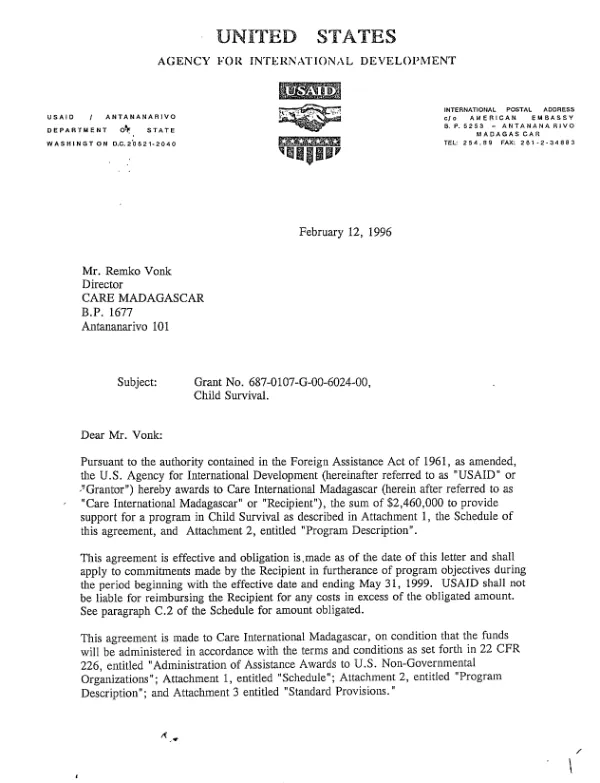
USAID grant no. 687-0107-G-00-6024-00 to CARE Madagascar in support of child survival
Sign inUSAID. MISSION TO MADAGASCAR
USAID grant no. 687-0107-G-00-6024-00 to CARE Madagascar in support of child survival
Grant is provided to CARE under the Population Sector Support project to implement its "TOUCH" project to improve the health nutritional status of some 20,000 children aged 0-5 in 22 "fokontany" (neighborhoods) in the urban slums of Tana, Madagascar, by upgrading health and social services delivery, improving community sanitation and hygiene conditions, strengthening local institutions, and (eventually) developing household income opportunities.
1996
Sign in to readA free account is required to download.
Abstract
CARE will help local NGOs and other existing health services to improve the access to and improve quality of treatment for sick children and prevention services for families at risk. By the end of the project, participating health centers will be expected to have/provide all or most of the following: at least one medical staff member trained in integrated management of the sick child; pre/post natal services; breastfeeding/nutrition counseling; vaccinations; oral rehydration therapy units; family planning services or referrals; community outreach; referrals for respiratory infections and other acute problems; regular supply of drugs and contraceptives; cost recovery scheme; and health education. CARE will provide training for medical, paramedical, and social work personnel; IEC materials; certain essential drugs and health supplies and equipment; personnel supervision; short-term TA in technical areas; network creation for peer support; progress and impact monitoring; and center refurbishing and expansion. CARE will work with community groups and municipal services to provide safe means of excreta disposal, access to safe drinking water, and instruction in domestic, food, and personal hygiene. CARE will create a Community Action Committee in each participating neighborhood, train and supervise "animateurs," who will provide peer education and home visits, and install a water tap with apron for every 1,000 inhabitants and family latrines for one-half of the households in participating neighborhoods. In addition, CARE will help to develop community-based systems for: monitoring hygiene at trouble spots (e.g., canals, street food vendors); household-level outreach and surveillance; and financing of the improved water supply. To help ensure sustainability, CARE will strengthen the capacity of partner organizations (local NGOs, government services, and community groups such as Action Committees) to respond to health and environmental issues. CARE will provide its partners with TA in organizational development and assist them, where needed, to achieve NGO status with the government; CARE will also provide training and TA in basic management, planning, fundraising, financial management, monitoring, and networking. Finally, to address the root cause of malnutrition -- poverty -- CARE will develop a separate project proposal for activities to increase the purchasing power of households, especially those headed by women. Models of activities used in other urban poverty relief programs, such as small credit programs, skills training, cooperatives, and labor-intensive remunerative activities, will be adapted for this component.
Related documents