ABT ASSOCIATES
USAID Dairy Competitiveness Project Quarterly Report April-June 2009
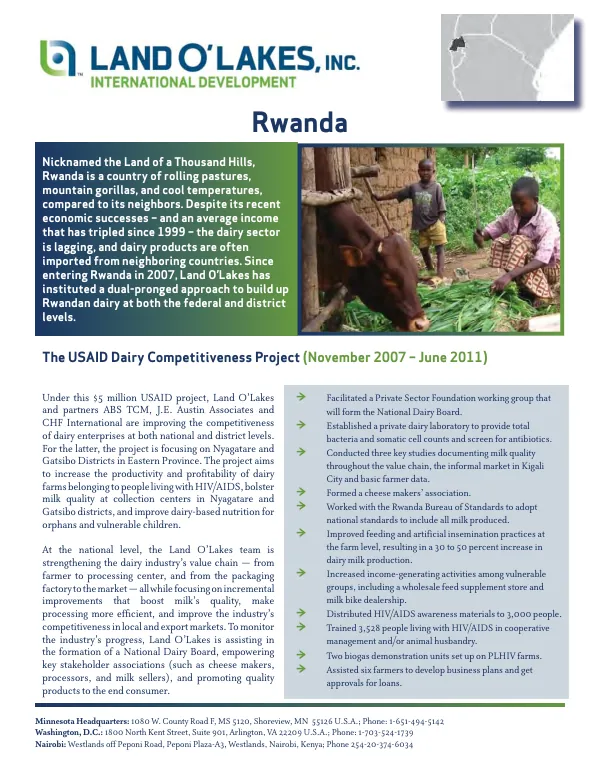
The USAID Dairy Sector Competitiveness Project in Rwanda began in November 2007 and is set to conclude in November 2012.
2009 · 50 pages
Sign in to readA free account is required to download.
Abstract
The project aims to increase the competitiveness of the Rwandan dairy sector by improving the efficient and profitable flow of quality milk and dairy products through the dairy value chain. The project targets increasing access to economic opportunities for vulnerable populations, including people living with HIV/AIDS (PLWHA) and orphans and vulnerable children (OVC). The project is implemented by Land O'Lakes, Inc. in partnership with several organizations, including CHF International, J.E. Austin Associates, Inc., and ABS-TCM Ltd. The project's strategy focuses on a market-driven, value-chain, low-subsidy approach to dairy sector development, emphasizing the development of local partners to provide technical services, build capacity, and strengthen markets for productivity-enhancing inputs and services. During the quarter of April to June 2009, the project made significant progress in several areas. The National Dairy Board task force made a breakthrough in organizing meetings between ministries, agencies, and the private sector to build a framework for initiating a National Dairy Board. The project also worked on forming additional associations or cooperatives to represent large groups in the informal sector. On the competitiveness side, the project advanced on several fronts, including milk quality. The project helped DQAL, the company formed for the central laboratory grant, to restructure its business model and explore incubator facilities that would be inexpensive and allow the company to grow. Several opportunities were found, and DQAL settled on developing several satellite labs in strategic parts of the country. At the farm level, the project showed that incentive payments to farmers based on actual bacteria counts work to improve milk quality. The test was done in a cooperative in Gicumbi, and when farmers were offered 10 RWF/liter if they met minimum COMESA standards, their counts dropped from 50 million to under 2 million. The project is now ramping up to take on 12 collection centers in Nyagatare/Gatsibo districts with a similar program. The project also collaborated with Project Rwanda to develop the milk bike, originally designed to transport coffee, but now adapted to haul milk or feed. The two projects are working together to set up a dealership in a PLWHA association in Nyagatare. At the farm level, the project had a tremendous impact on the livelihoods of PLWHA in five target cooperatives. Six farmers completed business plans and applied for loans to expand their operations. The loans are currently pending. The project also developed feeding plans with ABS-TCM, consisting of supplementing molasses, urea, and Bovatec to improve milk production. The project's progress is expected to lead to increased competitiveness of the Rwandan dairy sector, improved milk quality, and increased access to economic opportunities for vulnerable populations.