CLINTON HEALTHCARE ACCESS INITIATIVE
USAID | DELIVER PROJECT Overview in India, June 2015
The USAID | DELIVER PROJECT is a partnership between USAID and various organizations to improve health outcomes in developing countries by increasing the availability of health supplies.
2015 · 2 pages
Sign in to readA free account is required to download.
Abstract
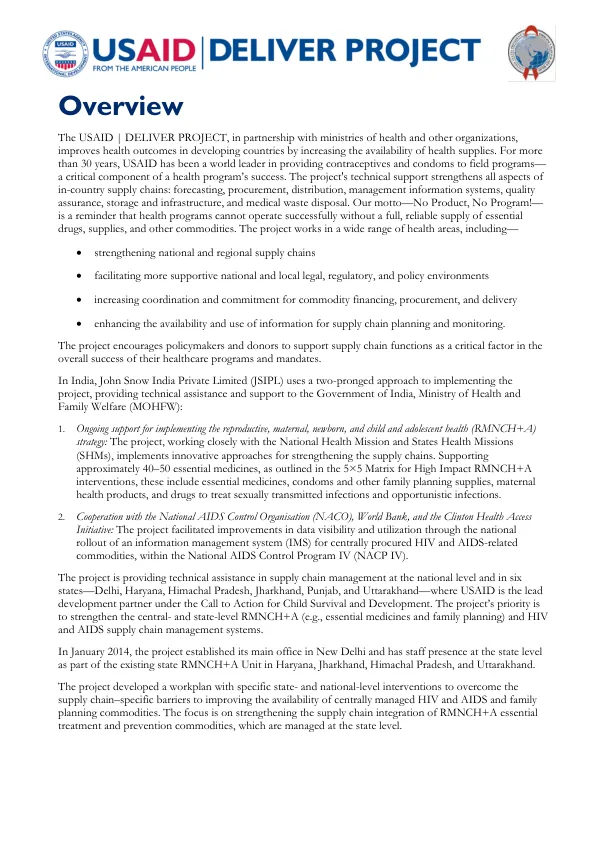
This initiative has been a world leader in providing contraceptives and condoms to field programs for over 30 years, recognizing that health programs cannot operate successfully without a full, reliable supply of essential drugs, supplies, and other commodities. The project's motto, "No Product, No Program!", emphasizes the critical role of supply chain management in healthcare success. The project's technical support strengthens all aspects of in-country supply chains, including forecasting, procurement, distribution, management information systems, quality assurance, storage and infrastructure, and medical waste disposal. In India, the project is implemented by John Snow India Private Limited (JSIPL) in partnership with the Government of India, Ministry of Health and Family Welfare (MOHFW). The project focuses on strengthening national and regional supply chains, facilitating supportive national and local legal, regulatory, and policy environments, and increasing coordination and commitment for commodity financing, procurement, and delivery. Key project activities in India include landscape reviews and quantitative data analysis, supply chain systems strengthening, capacity building and supply chain champions, and commodity security, coordination, and partnership. The project has conducted baseline qualitative assessments in Haryana and Jharkhand to document challenges related to commodity availability and management, and has facilitated state-level qualitative diagnoses of family planning and essential medicines-related supply chains in Himachal Pradesh, Punjab, and Uttarakhand. The project has also reviewed, tested, and deployed integrated district-level standard operating procedures for inventory control and store management of selected RMNCH+A and HIV and AIDS commodities in eight model districts in four states. Capacity building is a critical component of the project, with training provided to over 500 health managers and supply chain professionals from state health missions in Haryana, Himachal Pradesh, Jharkhand, and Uttarakhand. The project has also trained state instructors to support the rollout of approved standard operating procedures, and has trained pharmacists, medical officers, nurses, and auxiliary nurse-midwives from over 20 hospitals, 50 community health centers, and 160 primary healthcare centers in eight model districts in four states. The project has also identified leaders from six states to participate in an experiential leadership series focused on engaging with state health mission executives to address their toughest supply chain challenges. The project has made significant progress in strengthening supply chain integration of RMNCH+A essential treatment and prevention commodities, which are managed at the state level. The project has also assisted state health missions and state RMNCH+A units to identify and include key supply chain actions in their annual project implementation plans, and has advised the MOHFW and its information technology-affiliated stakeholders on using district standard operating procedures to tailor an India-based electronic logistics management information system to state-specific supply chain specifications. The project has also assisted NACO in hiring procurement and logistics coordinators at the national, regional, and state level to support the NACP IV.