CHEMONICS
USAID/E-PESO PROJECT Final Report (January 2021)
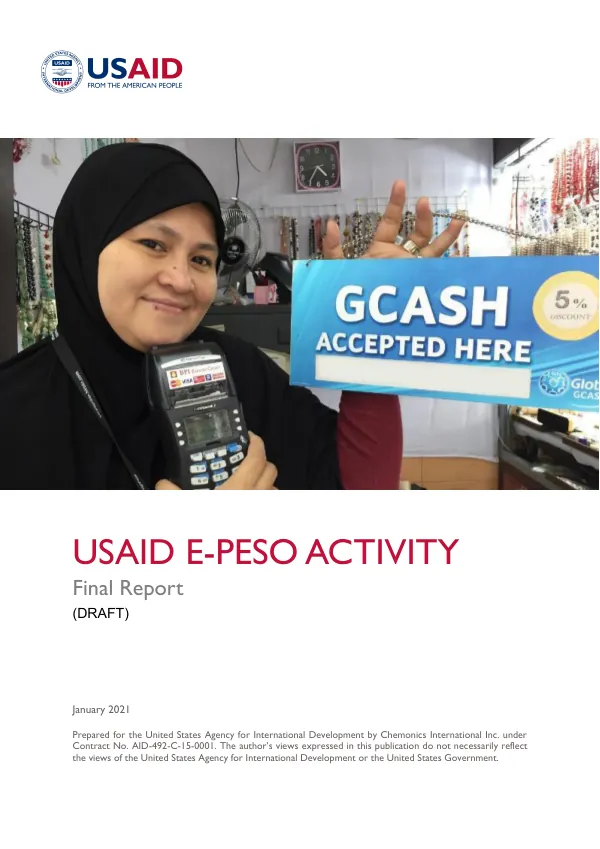
The USAID E-PESO Activity aimed to transition the Philippine economy from cash/checks to electronic payments for broader-based economic growth and financial inclusion.
2021 · 143 pages
Sign in to readA free account is required to download.
Abstract
The project achieved this goal during its period of performance from March 18, 2015, to February 17, 2021. From 1% share in 2015, e-payments usage increased to 10% based on the December 2019 report of the Better Than Cash Alliance (BTCA). The project accomplished sustainable initiatives that strongly positioned the Philippines to greater adoption of e-payments. On improving the enabling environment for e-payment usage, USAID/E-PESO assisted the Bangko Sentral ng Pilipinas (BSP) in formulating the National Retail Payments System (NRPS) to establish a governance and regulatory framework for a safe, reliable, efficient, and interoperable retail payments system. The project also provided technical assistance to the BSP in formulating related policies on the establishment of the Payments System Management Body (PSMB) and the implementation of settlement security accounts to eliminate settlement risks for real-time transactions. These successful reforms propelled the wide adoption of e-payments services under the NRPS to 34.5 million transactions valued at Php 531 billion for the month of December 2020 alone. Moreover, these reforms made it easy for innovative digital payments providers to launch new digital payments services in the market to promote competition, efficiency, and better customer experience. To help boost the cybersecurity capability of the BSP, USAID/E-PESO conducted a cybersecurity policy review, capacity building, and compliance monitoring. The project also supported the expansion of e-payment infrastructure by providing policy formulation support to BSP on establishing automated clearing houses (ACH) as a component of the e-payments governance structure under the NRPS. These policies helped the payments industry establish the PESONet ACH for batch electronic credit transfers and InstaPay ACH for low-value real-time credit transfers. Upon the establishment of the ACHs, the clearing switch operators (CSOs) were commissioned in accordance with the NRPS. Additionally, USAID/E-PESO supported the BSP, PPMI, and the payments industry in launching the eGovPay digital bills payment system. The project also worked with BSP and a representative group of financial institutions to help them establish a shared cash agent network that will multiply the number and the reach of financial access points most efficiently to onboard customers and service the cash deposit and withdrawal of more customers, especially those in remote areas. On driving e-payments adoption by government, USAID/E-PESO assisted the Department of Social Welfare and Development (DSWD) through policy formulation support and the development of financial literacy modules in transitioning the accounts where the beneficiaries receive their social grants from limited-purpose reloadable electronic gift cards or "cash cards" to fully functional transaction accounts. Once fully implemented by DSWD, about 4.5 million conditional cash transfer beneficiaries will have access to financial services such as digital payments, savings, credit, investments, and insurance for deeper financial inclusion. The project also conducted two assessment studies to inform policy formulation on further boosting usage of e-payments, especially by businesses. The assessment pointed out that revenue regulations requiring businesses to keep hardcopies of invoices and official receipts (ORs) were keeping businesses in checks/cash. A recommendation to implement an e-invoicing and e-OR framework in the country would solve the issue and gain some other major benefits. The assessment was well-received and referenced by the BSP, BIR, PPMI, and the payments industry, leading to a follow-on assessment to see how BIR may implement the PEPPOL e-invoicing framework in the Philippines.