USAID DEC
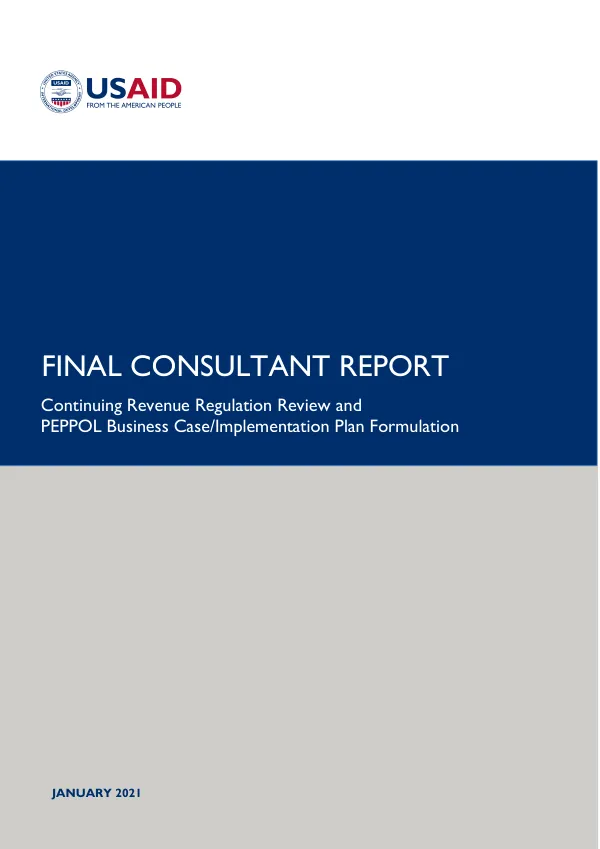
Final Consultant Report for USAID ePeso Activity: Continuing Revenue Regulation Review and PEPPOL Business Case
Sign inCHEMONICS
Final Consultant Report for USAID ePeso Activity: Continuing Revenue Regulation Review and PEPPOL Business Case
The Continuing Revenue Regulation Review and PEPPOL Business Case/Implementation Plan Formulation study was conducted by Sycip Gorres Velayo & Co (SGV & Co.)
2021 · 18 pages
Sign in to readA free account is required to download.
Abstract
as commissioned by USAID as part of the E-PESO Activity. The study aimed to review proposed immediate and medium-term recommendations, engage with stakeholders in a discussion on implications of these solutions, and identify and analyze regulatory policies and guidelines. Additionally, the study formulated a business case on PEPPOL implementation in the Philippines in terms of economic, financial, political, legal, technology, commercial, operational, organizational, and personnel. The preliminary work began with the development of a detailed workplan, which contained a daily record of activities to be conducted throughout the engagement. This also included deliverables and their respective deadlines, which served as payment milestones throughout the engagement. The engagement started with a kick-off meeting of the project team consisting of USAID E-PESO, IBM-Sterling, and SGV. The development of the discussion paper on the recommended immediate measures began with research and review of proposed solutions and identification of relevant regulations, policies, and guidelines. Plenary sessions with key stakeholders on implications and considerations of these solutions soon followed. These stakeholders included regulating bodies, private companies, and financial institutions. The study conducted three stakeholder sessions, which involved discussions with various companies and organizations, including HSBC, P&G, PLDT/Smart, Unilever Philippines, and the Philippine Payments Management, Inc. The discussions centered on proposed intermediate solutions on compliance to regulatory requirements, including e-invoicing without the e-invoicing system, accepting structured data, data exchange ecosystem, tax audit attestation and analytics, and sources of data and data requirements. The stakeholders raised several key points, including the importance of collecting structured data, the benefits of using these techniques, and the need for applications to make this solution workable for the full target state. The study also identified the three planks of the BIR for transformation efforts, which include infrastructure, prioritization of applications with provision for sandbox, and fusion of workflow and analytics. The KOICA interface was identified as the channel through which the BIR will get the data from taxpayers, with storage responsibility falling on the buyers and suppliers. The accreditation process of CAS by BIR was focused on data being produced, while the accreditation process for AP requires compliance of both the data being produced and the standards set for interoperability, among others. The study concluded that PEPPOL standards are needed for the implementation of the e-invoicing system, and that the BIR will need to provide clear guidelines on the data to be made available by the various parties. The study recommended stronger engagement with BIR key decision-makers, better session dynamics with BIR, and early coordination with KOICA. The study also identified immediate and medium-term solutions, including the development of a target e-invoicing framework and the harmonization with KOICA, and the implementation of a proof-of-concept. The study's findings and recommendations are intended to serve as a guide for the implementation of the e-invoicing system in the Philippines, and to provide a clear path for PEPPOL implementation. The study's conclusions and recommendations are based on the discussions and feedback from the stakeholders, and are intended to support the development of a robust and effective e-invoicing system in the Philippines.