FAMILY HEALTH INTERNATIONAL
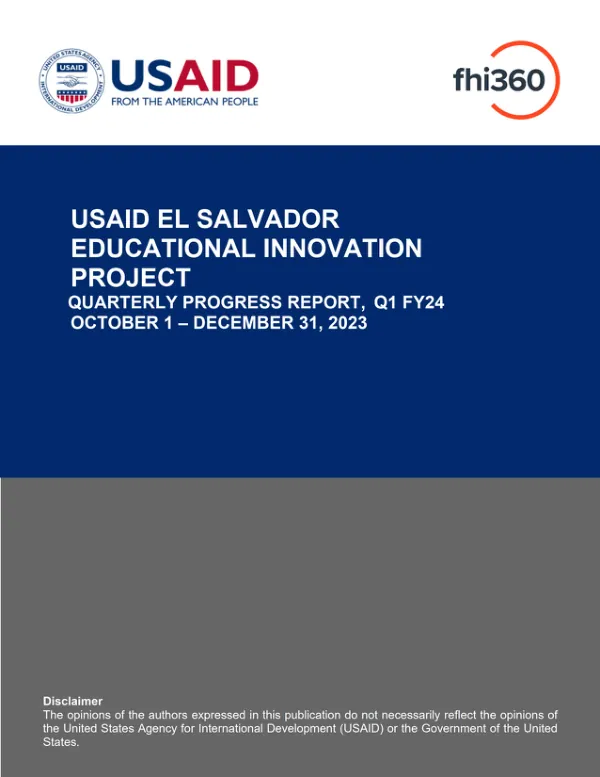
USAID Educational Innovation Project Quarterly Progress Report Q1 FY24
The Educational Innovation Project in El Salvador, funded by USAID, aims to improve the quality of teaching and learning in Salvadoran classrooms.
2024 · 66 pages
Sign in to readA free account is required to download.
Abstract
The project's first quarter of year two (Q1 FY24) report highlights progress in implementing planned activities. During Q1 FY24, the project initiated a teacher training process to improve teaching practices. Second and third-grade teachers were trained on integrating areas of focus, including instruction in language, mathematics, Universal Design for Learning (UDL), Social-emotional Learning (SEL), and Information and Communication Technologies (ICT). The project observed signs of impact on classroom practice in three areas: better and integrated lesson planning, functioning of peer networks, and improvement in knowledge and application of the Ministry's new pedagogical model. The project provided technical support to the Ministry of Education, Science, and Technology (MINEDUCyT) in constructing how the pedagogical model is applied in the classroom through teacher training. This support promotes evidence-based pedagogical approaches with teachers, offering El Salvador a more impactful and sustainable path for improving teaching and learning quality. In Objective 2, the project's Monitoring Committee defined a research agenda for basic education, identifying six research areas and 28 research priorities. The committee aimed to deepen knowledge and improve decision-making to enhance basic education quality. Notable accomplishments during Q1 FY24 include: - 578 second and third-grade teachers completed integrated and practical training on the pedagogical model, improving instruction in language, math, SEL, UDL, and ICT. - Eight out of ten teachers reached "achieved" and "in progress" levels in observed teaching practices, such as participatory reading and integral learning and development practices. - 25 teachers from five designated "pilot" educational centers demonstrated enhanced proficiency in understanding the environment, cultivating technological skills, and strategically planning activities and resources within the STEAM methodology. - 253 teachers from the fourth, fifth, and sixth grades significantly enhanced their information and communication technology skills, aligning them with effective learning practices. - 264 teachers received individual coaching through 88 school visits, observing signs of impact in classroom accompaniment, including the layout of the classroom for collaborative work and the implementation of guided reading techniques. - 47 professionals participated in training on UDL and its practical application within the project's framework, emphasizing integrating UDL principles into training programs and providing educational coaching within school settings. - 40 language specialists were trained in the technical and pedagogical content of the National Literacy Strategy. - 112 teachers from 56 schools prioritized by the project were trained in Psychological First Aid, empowering them to identify, accompany, and refer children experiencing emotional difficulties. The project's progress in Q1 FY24 demonstrates its commitment to improving teaching and learning quality in Salvadoran classrooms, with a focus on evidence-based pedagogical approaches and teacher training.
Related documents