USAID DEC
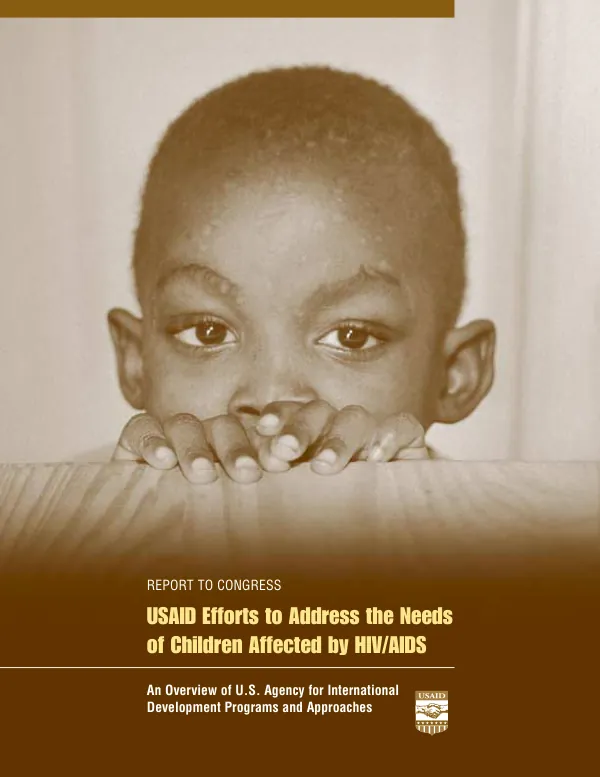
USAID efforts to address the needs of children affected by HIV/AIDS : an overview of U.S. Agency for International Development programs and approaches
Sign inTVT ASSOCIATES
USAID efforts to address the needs of children affected by HIV/AIDS : an overview of U.S. Agency for International Development programs and approaches
At the end of 1999, the Joint United Nations Programme on HIV/AIDS (UNAIDS) estimated that 13.2 million children under age 15 worldwide -- 90% of them in sub-Saharan Africa -- had lost their mother or both parents as a result of AIDS.
2001
Sign in to readA free account is required to download.
Abstract
Besides these victims, millions more children live with ill parents and so become the primary caregivers for these parents, as well as for younger siblings, and others. These children are more likely to drop out of school, suffer from malnutrition, be compelled to work in order to survive, be forced from their home due to stigma and discrimination, or find themselves at risk of HIV infection. This report to Congress documents USAID actions to meet the needs of children affected by HIV/AIDS, with emphasis on expanding access to food and education. Introductory sections of the report describe the growing threat posed by HIV/AIDS to children, USAID"s strategic response to the situation, the special role of food and education, and the Agency"s emergence as a global leader in responding to HIV/AIDS in general and its effect on children in particular. The next section profiles USAID-supported community-based interventions on behalf of children affected by HIV/AIDS in Malawi, Rwanda, Burkina Faso, Kenya, Zambia, Uganda, and South Africa, as well as related policy, research, and information exchange efforts. USAID currently funds more than 40 activities in 18 developing countries on behalf of children affected by HIV/AIDS. Though many of these projects are just getting under way, local NGOs and community-based organizations (CBOs) are already benefitting from U.S. assistance to better meet the needs of orphans and vulnerable children in their midst. Funding sources for these programs include child survival funds, HIV/AIDS funds for orphans and vulnerable children, Title II Food for Peace funds, and basic education funds. USAID-funded community interventions to support orphans and vulnerable children include establishing volunteer visiting programs; providing material support such as food, school fees, shelter, clothing, and blankets; providing economic strengthening activities, including credit and savings programs targeted at orphans and children affected by HIV/AIDS; providing counseling and ongoing psychosocial support; development of community schools; initiating community-based child care; providing peer support and guidance from older children to younger children; supporting parents in planning for the future care of their children; providing protection from abuse; and reducing stigma and discrimination aimed at persons living with HIV/AIDS and their families. Future USAID plans to mitigate the impact of HIV/AIDS on children are detailed in conclusion.
Related documents
![[International] HIV/AIDS Alliance and IPC [Initiative Privee et Communautaire de Lutte contre le VIH/SIDA] proposal assessment : assisting orphans and vulnerable children in Burkina Faso](https://covers.devme.ai/gen/32434.webp)
![Assessment of the [International HIV/AIDS] Alliance/IPC [Initiative Privee et Communautaire de Lutte contre le VIH/SIDA] OVC [orphans and other vulnerable children] project in Burkina Faso](https://covers.devme.ai/gen/5420.webp)
![Assessment of the [International HIV/AIDS] Alliance/IPC [Initiative Privee et Communautaire de Lutte contre le VIH/SIDA] OVC [orphans and other vulnerable children] project in Burkina Faso](https://covers.devme.ai/gen/48889.webp)