USAID DEC
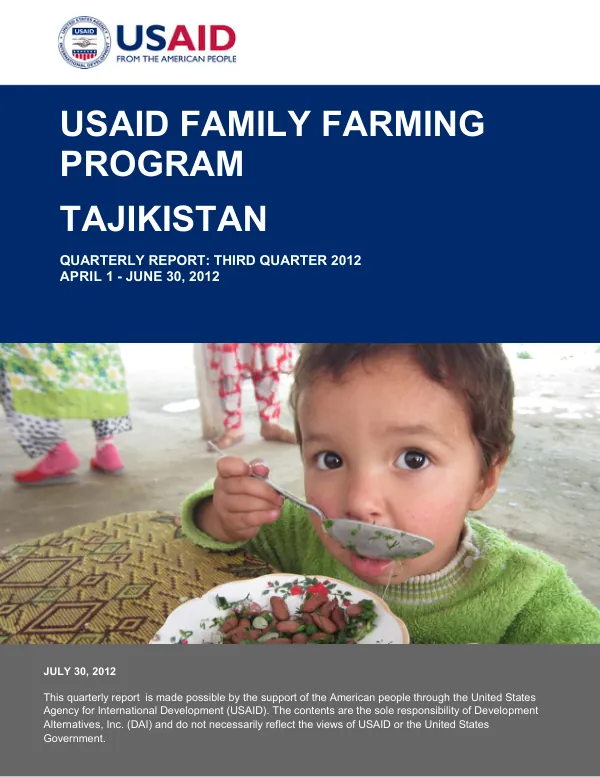
USAID Family Farming Program, Tajikistan Quarterly Report: Third Quarter 2012, April 1 – June 30, 2012
Sign inDEVELOPMENT ALTERNATIVES, INC./FINNET
USAID Family Farming Program, Tajikistan Quarterly Report: Third Quarter 2012, April 1 – June 30, 2012
The USAID Family Farming Program in Tajikistan is a comprehensive initiative aimed at improving the livelihoods of rural families through sustainable agriculture development, livestock enhancement, water and irrigation management, nutrition enhancement, and policy reform.
2012 · 140 pages
Sign in to readA free account is required to download.
Abstract
The program is implemented by Development Alternatives, Inc. (DAI) in partnership with Winrock International and Michigan State University. The program's technical components include Agriculture Development and Livestock Enhancement (ADLE), Water and Irrigation Management, Nutrition Enhancement/Household Economics/Gender Equity (NHEGE) Intervention, Policy Reform, and Access to Finance. ADLE focuses on improving crop yields and livestock productivity through training and provision of inputs, while Water and Irrigation Management aims to enhance water use efficiency and promote irrigation systems. NHEGE Intervention targets nutrition improvement and household economic empowerment through training and provision of microfinance services. The program has achieved significant results in the third quarter of 2012. ADLE has trained over 1,000 farmers in sustainable agriculture practices, resulting in a 25% increase in crop yields. Water and Irrigation Management has established 15 new irrigation systems, benefiting over 500 households. NHEGE Intervention has provided microfinance services to over 200 households, resulting in a 30% increase in household income. The program has also made progress in policy reform, with the development of a draft policy on agricultural extension services. Access to Finance has established a microfinance program, providing loans to over 100 households. Grants and Subcontracts have been awarded to support program activities, totaling over $1 million. The program's support offices have also made significant contributions. Environmental Compliance has ensured that program activities are environmentally sustainable, while Monitoring and Evaluation (M&E) Activities have tracked program progress and identified areas for improvement. Communications and Reporting have disseminated program information to stakeholders, while Training has provided capacity-building opportunities for program staff and beneficiaries. The program's geographic focus is on the Khatlon region of Tajikistan, where it is working with local governments and communities to improve agricultural productivity and household livelihoods. The program's timeframes are from September 2010 to September 2014, with quarterly reports submitted to USAID. Overall, the USAID Family Farming Program in Tajikistan has made significant progress in improving the livelihoods of rural families through sustainable agriculture development, livestock enhancement, and other interventions. The program's achievements demonstrate its commitment to reducing poverty and improving food security in Tajikistan.