DEVELOPMENT ALTERNATIVES, INC./FINNET
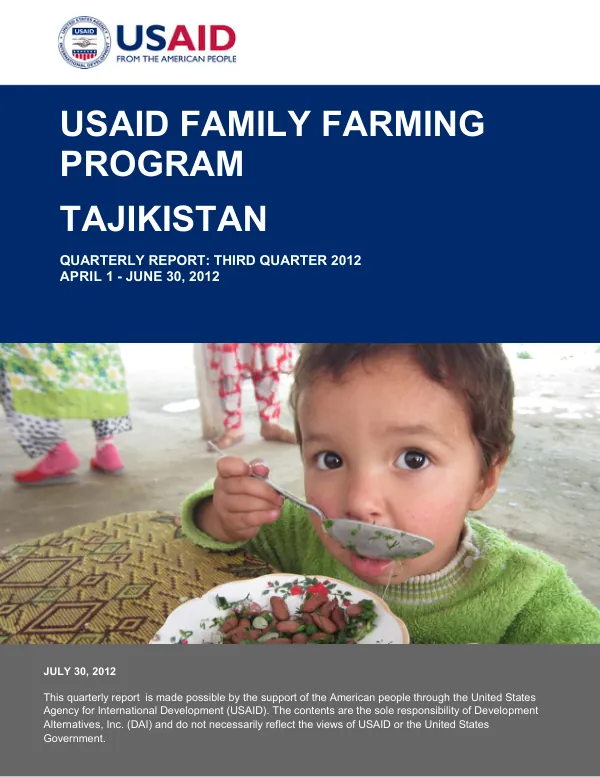
USAID Family Farming Program, Tajikistan: Quarterly Report: Second Quarter 2012
The USAID Family Farming Program in Tajikistan aims to improve food security and create new, or strengthen existing, Water User Associations (WUAs).
2012 · 31 pages
Sign in to readA free account is required to download.
Abstract
The program delivers integrated technical assistance to selected food insecure communities in Tajikistan, addressing agriculture and livestock development, water management, nutrition and livelihoods, access to finance, and policy reform. The program has been designated as the implementation vehicle for the "Feed the Future" (FtF) initiative in Tajikistan, a global hunger and food security initiative. The program's technical components include Agriculture Development and Livestock Enhancement (ADLE) activities, water management interventions, nutrition enhancement and household economics, policy reform, access to finance, and monitoring and evaluation. The ADLE activities focus on improving access to agricultural inputs, establishing greenhouses and agriculture input dealers, and enhancing market entry for smallholder farmers. In the second quarter of 2012, the ADLE unit underwent a rapid close-out of existing activities in the Kulob and Vose districts, with a final date of May 10, 2012. The unit then established a working relationship with local government structures in the newly designated Area of Operation (AOR), which includes 12 districts in the Khatlon Oblast. The ADLE unit conducted focus group sessions, surveys, and developed a working relationship with local formal and informal government structures, farmers, input dealers, and traders. The ADLE unit has begun substantial actions to increase nutrition and income for household level producers, including establishing four complexes with 10 greenhouses each, establishing three new agriculture input dealers at the village level, and developing a prototype for onion/garlic bulking centers. These activities are expected to have far-reaching positive consequences, including a reduction of nutritional issues, an increase in production, and an increase in income for smallholder farmers. The program has also conducted a thorough review of existing input dealers in the AOR and is focusing on identifying village farming areas that do not have access to inputs. The ADLE unit has signed MOUs with three emerging entrepreneurs with sound agricultural skills and is supporting them in developing their business and improving access to agricultural inputs. The program's planned expansion and scaling up exercises through establishment of self-help groups via NGOs throughout the AOR were postponed at the request of USAID. An RFP was let, NGOs have been selected, and preliminary proposals have been accepted. The ADLE unit is awaiting input by MEAS and authorization to move forward with final NGO negotiations, selection, contracting, and self-help group identification and management. The program's activities are expected to have a significant impact on the rural sector, including a reduction of nutritional issues, an increase in production, and an increase in income for smallholder farmers. The program's focus on improving access to agricultural inputs, establishing greenhouses and agriculture input dealers, and enhancing market entry for smallholder farmers is expected to have a positive impact on the livelihoods of rural communities in Tajikistan.