USAID DEC
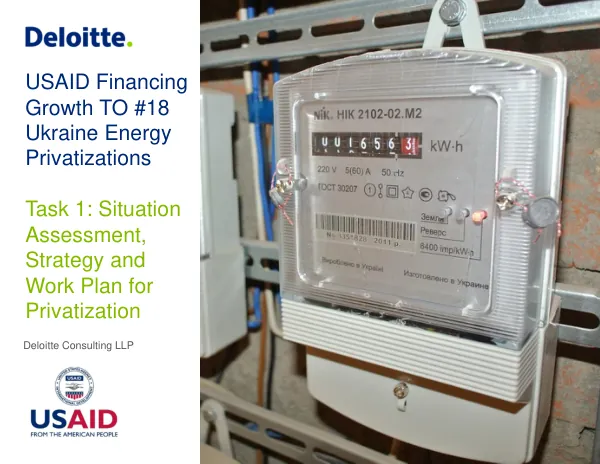
USAID Financing Growth TO #18 Ukraine Energy Privatizations Task 1: Situation Assessment, Strategy and Work Plan for Privatization
Sign inDELOITTE CONSULTING, LLP
USAID Financing Growth TO #18 Ukraine Energy Privatizations Task 1: Situation Assessment, Strategy and Work Plan for Privatization
The Ukrainian energy sector is undergoing significant changes, with the State Property Fund of Ukraine (SPFU) planning to privatize stakes in several electricity state-owned enterprises (SOEs) in 2016.
2016 · 59 pages
Sign in to readA free account is required to download.
Abstract
The privatization plan includes six regional oblenergos, which are majority-owned by the SPFU. These oblenergos are Kharkivoblenergo, Mykolaivoblenergo, Khmelnitskoblenergo, Ternopiloblenergo, Zaporozhyaelectric, and Cherkassyoblenergo. The six oblenergos have varying levels of revenue and profitability, with Kharkivoblenergo generating the highest revenue of 3.948 billion UAH in 2014. The oblenergos also have different levels of electricity losses, with Zaporozhyaelectric experiencing the highest losses of 36.6% in 2015. The oblenergos have a mix of residential and non-residential customers, with Kharkivoblenergo having the highest percentage of residential customers at 35.5% in 2015. The privatization plan is part of the Ukrainian government's efforts to reform the energy sector and increase efficiency. The government has decreed that the SPFU will sell all shares in the oblenergos by May 2017. The privatization process is expected to be complex, with several Ukrainian and Russian elites holding significant stakes in the oblenergos. Deloitte Consulting LLP was engaged by USAID to conduct a situation assessment and provide recommendations on the privatization of the oblenergos. The consulting firm collected financial and due diligence information from the oblenergos and held discussions with their management teams. Deloitte also met with various stakeholders, including government officials and energy experts, to gain a deeper understanding of the Ukrainian energy market. The situation assessment highlights several key challenges facing the oblenergos, including high electricity losses, low EBITDA margins, and a lack of transparency in their financial reporting. The assessment also notes that the oblenergos have a high level of debt, with some companies having debt-to-equity ratios of over 100%. The assessment concludes that the privatization of the oblenergos will require significant investment and reform efforts to improve their financial performance and operational efficiency. The assessment also highlights the importance of transparency and accountability in the privatization process. The report notes that the SPFU has a critical role to play in ensuring that the privatization process is transparent and that the oblenergos are held accountable for their financial performance. The report also recommends that the government establish clear guidelines and regulations for the privatization process to ensure that it is fair and transparent. In terms of the privatization strategy, the report recommends that the SPFU consider a phased approach to privatization, starting with the most profitable and efficient oblenergos. The report also recommends that the SPFU establish a clear timeline for the privatization process and ensure that all stakeholders are informed and engaged throughout the process. The report also provides an analysis of the current and future electricity market in Ukraine, highlighting the challenges facing the sector, including high electricity losses, low EBITDA margins, and a lack of transparency in financial reporting. The report notes that the Ukrainian government has taken steps to reform the energy sector, including the introduction of a new electricity market law and the establishment of a new regulatory body. Overall, the report provides a comprehensive analysis of the Ukrainian energy sector and the challenges facing the privatization of the oblenergos. The report highlights the importance of transparency and accountability in the privatization process and provides recommendations for the SPFU and the government on how to ensure a successful privatization process.
Related documents